Newsom's 548 commutations make death sentences life without parole, but court review remains
What Newsom's commutation of 548 death sentences does: the new sentence as ABC7 reported it, how it differs from a pardon or a moratorium, why about two-thirds still need the state Supreme Court, where prisoners are held, and what the sources say about families and a future governor.

views
The 548 sentences now read life without parole, but about two-thirds are not final until the California Supreme Court signs off. ABC7 reported that Gov. Gavin Newsom would commute every death sentence in the state to life without parole. The Death Penalty Information Center says the grant took effect at once for about one-third of death row.
CalMatters describes the move as clearing California death row for the first time since the late 19th century. That phrase made me curious. The same coverage keeps coming back to a court. I wanted to know what commuting 548 death sentences actually does, and whether anyone can reverse it.
The announcement came on Nov. 5, 2026, according to the Death Penalty Information Center, or DPIC. The group calls it the largest mass clemency in US history.
My first small question was scale. Measured against the whole country, the 548 people made up more than a quarter of the nation's condemned, by CalMatters' count. Newsom put his intent in one line, quoted in the same report: "These offenders will die in prison but not by our hand."
Only one other state can be set beside California in these sources. The Death Row USA report for spring 2026, as summarised by the Death Penalty News blog, counted 1,993 people on death row in the first quarter of 2026. California and Pennsylvania together held 681 of them, or 34.2 percent. The summary gives the two states only as a pair, and none of the sources breaks out Pennsylvania or any other state on its own.
DPIC gives a separate national figure: about 1,388 people on US death row, the lowest since 1984. That count and the 1,993 come from different sources and different dates. They sit side by side, not on one line.
What does a commutation change?
The new term comes from ABC7's report: Newsom said he would commute every death sentence in the state to life without parole.
The clemency power sits with the governor's office in Sacramento. The state constitution puts limits on it, as the next section shows.

A pardon is a different tool. The California Department of Corrections and Rehabilitation calls a governor's pardon "an acknowledgement from the Governor that a person has been rehabilitated." Its clemency page defines a pardon but not a commutation. Newsom's own words about the 548 point elsewhere. He said they will die in prison.
The third tool is the moratorium. Newsom issued one on executions in 2019, shortly after taking office, CalMatters says.
The parole board's new commutation and resentencing regulations do not cover the commuted prisoners, according to CalMatters. The same report says those newly sentenced to life "might get a chance later to be released."
How many of the 548 are final, and where are they held?
Next I wanted to know how many commutations count right now. About one-third of death row, DPIC says. The remaining two-thirds need review by the California Supreme Court before their commutations are final.
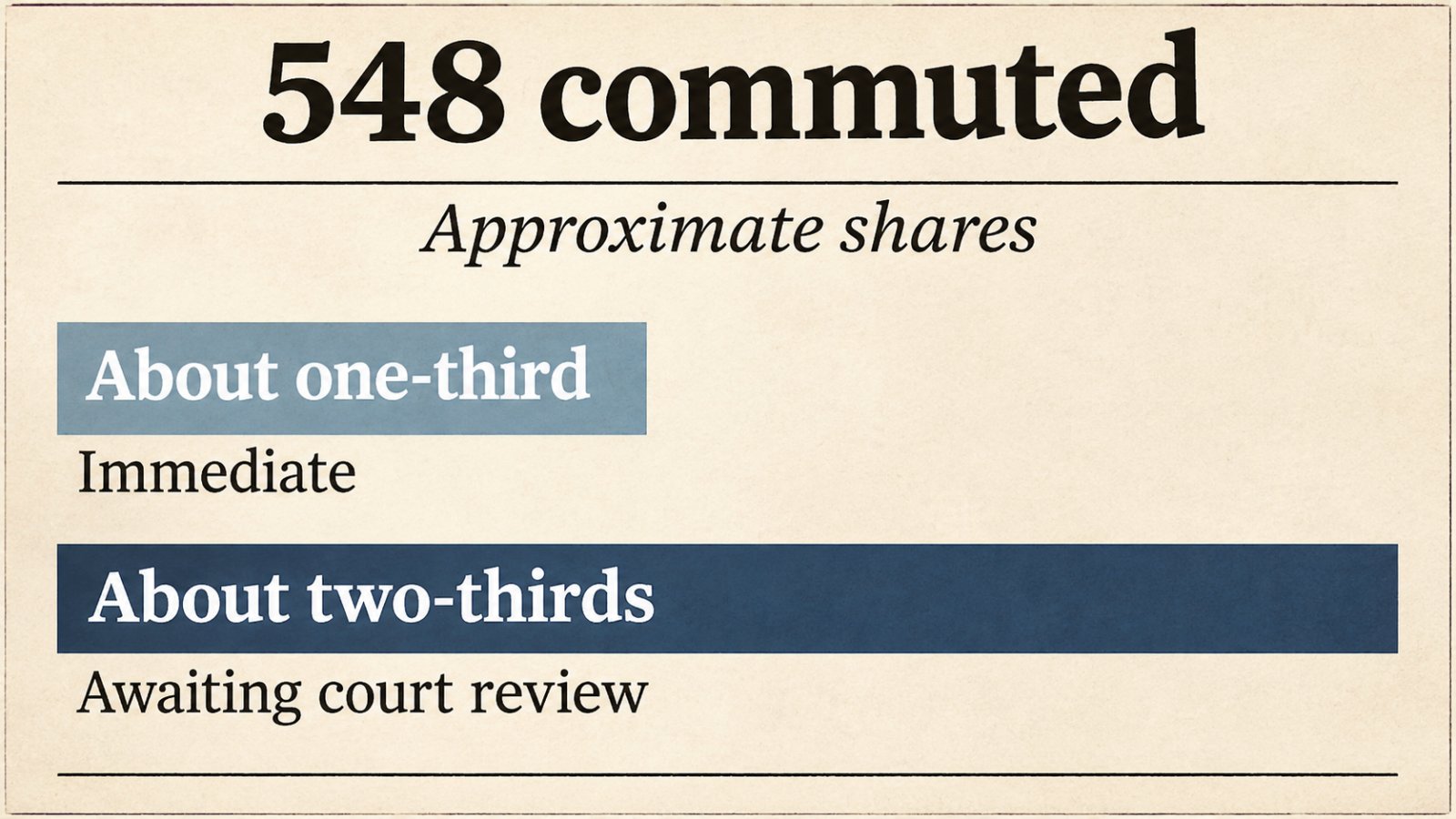
In the chart, look at the longer bar. The bars follow DPIC's rough fractions, so that bar is only about twice the other.
The reason for the wait sits in the state constitution. The CDCR clemency page notes that a governor "may not grant a pardon or commutation to a person twice convicted of a felony" without the Supreme Court's approval.
That rule made me want the size of the group. CalMatters puts it at nearly 400 prisoners convicted of multiple felonies. For each of them, four of the seven justices must sign off. DPIC speaks in fractions of death row, while CalMatters counts multiple-felony cases. The two outlets are describing different groupings.
As for where people are held, the men were cleared out of their individual cells in San Quentin, CalMatters reports. Its summary adds that they were distributed to 24 other facilities. Twenty women were moved into the general population at the Central California Women's Facility.
What can victims' families do?
Families have spoken on both sides. Schubert, of the Criminal Justice Legal Foundation, said families were not notified. In CalMatters' account, Schubert called the move "the most grotesque violation of victims' rights I've ever seen." Polly Klaas's sister, by the same account, supported it.
Support came in numbers too. Fifty victims' family members signed a letter urging clemency, in DPIC's count. Jess Nichol, quoted by the group, put the case plainly: "The system tells survivors that execution matters to our healing. It doesn't."
Can a later governor undo it?
The next governor is on record about executions in one respect. Gov.-elect Xavier Becerra has committed to extending the moratorium when he takes office, CalMatters reports. The outlet also calls the commutation more durable than a moratorium.
I also wanted to know how rare this step is. DPIC counts Newsom as the eighth governor of the modern era to grant clemency to everyone sentenced to death in his state.
None of the sources, CalMatters, DPIC, ABC7 or the CDCR clemency page, says whether a later governor could undo a commutation, when the Supreme Court will rule, what formal role families have, or how a later release might come about.
The record behind all this is short. DPIC counts 13 executions in California since 1978, with about $6 billion spent on capital punishment. The state had not executed anyone in more than 20 years, the group notes.
Thirteen executions since 1978, and 548 death sentences commuted in one announcement.

Rowena Dimaculangan
I write about weather, climate and the science behind the headlines, from typhoon forecasts to heat records. I live in Iloilo City, where the rainy season decides my plans.
View profile


Leave a Comment