The Wash Sale Rule Moves Your Loss to a Later Year, or Deletes It in an IRA
Ten dip-buying scenarios in one table, with the basis mechanics for averaging down, buying back, partial lots and an IRA repurchase. Also covers the purchases people miss: buying before the sale, DRIP, recurring buys, your spouse's account and the IRA, where the loss is gone for good.

views
If you buy the same stock, or something substantially identical, within 30 days before or after a sale at a loss, the loss is disallowed. In a taxable account it isn't gone. It's added to the cost of the new shares and comes back when you sell them. If the repurchase happens inside an IRA, the loss is gone permanently.
The window runs backwards as well as forwards. A reinvested dividend may count as a purchase, and so can a purchase in your spouse's account or your IRA. The rules here come from IRS Publication 550 and the statute behind it, with two secondary sources where noted. None of this is individual tax advice. Check your own lots against Pub 550, or ask a preparer, before you file.
"Tax-loss harvesting" implies the loss has already been collected. The wash sale rule decides whether it has, and in which year.
The scenarios, in one table
| What you did | Wash sale? | What happens to the loss |
|---|---|---|
| Bought more shares, then within 30 days sold the older, higher-cost lot at a loss and kept the new shares | Yes | Added to the basis of the replacement shares |
| Sold at a loss, bought the same stock back within 30 days after the sale | Yes | Added to the basis of the replacement shares |
| Sold at a loss, bought back more than 30 days after the sale, with no purchase in the 30 days before the sale | No | Allowed |
| Sold shares at a loss, bought back fewer than you sold inside the window | Partly | Deferred on the shares bought back, allowed on the rest |
| Dividend reinvested into the same stock inside the window | May trigger one (Fidelity) | If it does, deferred on the reinvested shares |
| Scheduled automatic buy of the same stock inside the window | Our sources don't exempt it; it is still an acquisition | Treat it like any other buy in the window |
| Spouse bought the same stock inside the window | Yes | Disallowed on your side; what happens to it afterwards is not covered in our sources |
| Same stock bought in your IRA or Roth IRA inside the window | Yes | Lost permanently |
| Sold one company's stock, bought a different company's stock | Ordinarily no | Allowed |
| Sold an ETF, bought another ETF built to track the same thing | No firm definition (Fidelity) | Uncertain |
The 30 days before the sale count too
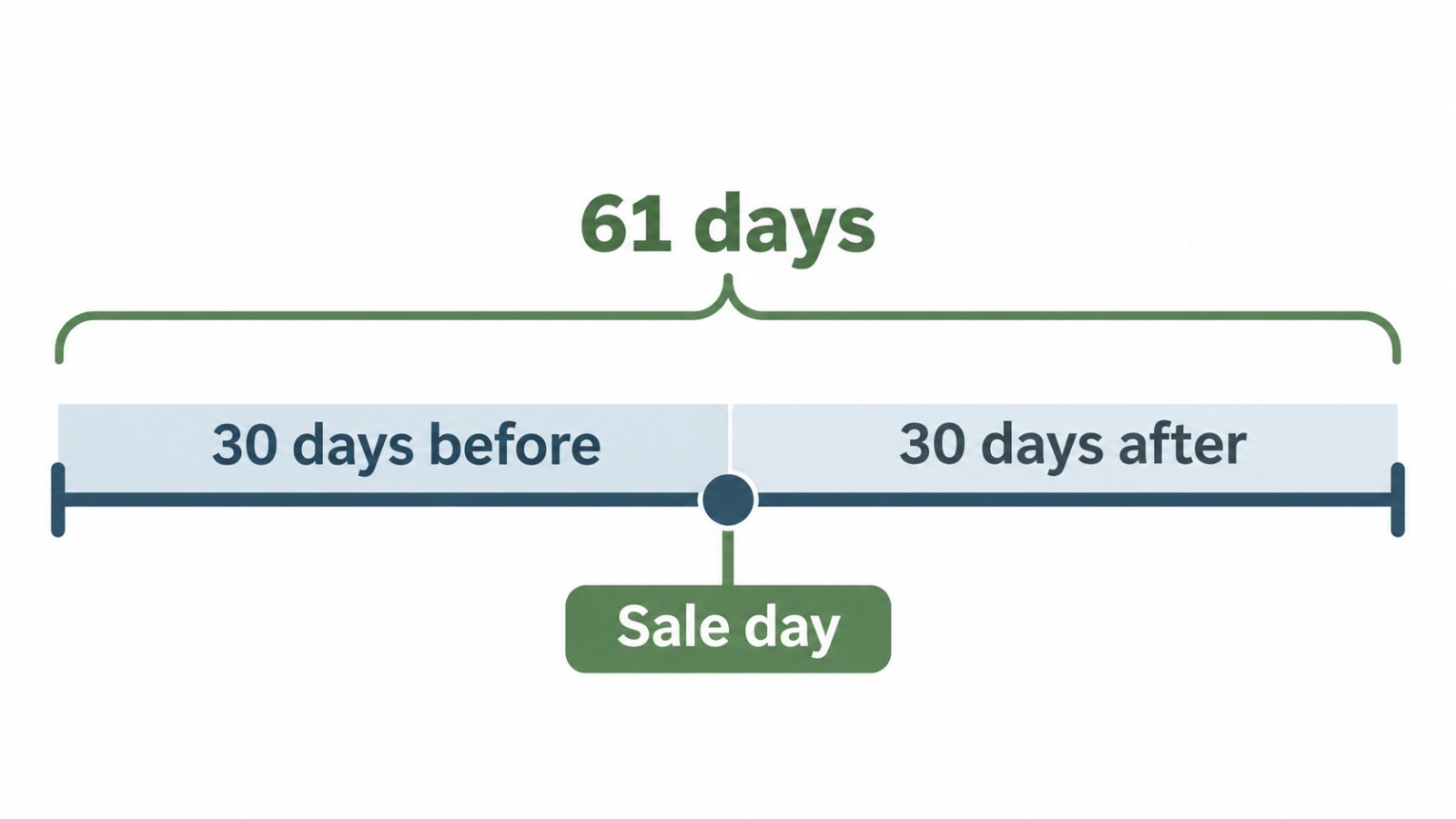
The window opens 30 days before the sale. 26 U.S.C. 1091(a) sets the period as "beginning 30 days before the date of such sale or disposition." Fidelity spells it out: "The 61-day period includes the sale date, the 30 days before the sale, and the 30 days after the sale."
The backwards half matters most if you average down. You hold a lot that has fallen in price. You buy the same number of shares again, then within 30 days sell the original lot at a loss and keep the cheaper lot. The replacement shares were bought inside the window, and the rule doesn't care that they came first.
- The loss is disallowed and added to the cost of the new lot.
- The statute's method, explained in the next section, gives the same basis: the old lot's basis, adjusted for the difference between the repurchase price and the sale price.
On paper you averaged down. For tax purposes, the cheap lot now carries the old lot's basis, adjusted for that price difference. Before you sell a losing lot, check 30 days back in that ticker as well as 30 days forward. If you averaged down in that time, either wait until the new lot is more than 30 days old and buy nothing for 30 days after the sale, or accept the deferral.
A disallowed loss moves into the replacement shares
In a taxable account a disallowed loss is not a lost loss. Pub 550 says to "add the disallowed loss to the cost of the new stock or securities." Section 1091(d) of the statute gets there a different way: the replacement shares take the basis of the shares you sold, adjusted for the difference in price. Both give the same number.
Say you sell a position at a loss and, within 30 days, buy the same number of shares back at a lower price.
- Pub 550 method: what you paid for the new shares, plus the disallowed loss.
- Statute method: the basis of the shares you sold, minus the amount by which the sale price exceeds the repurchase price.
Later you sell the new shares.
| No wash sale | Wash sale | |
|---|---|---|
| Loss allowed on first sale | The full loss | None |
| Basis of the new shares | What you paid | What you paid plus the disallowed loss |
| Result when the new shares are sold | Measured from what you paid | Gain smaller, or loss larger, by the disallowed loss |
| Net across both sales | Same | Same |
The net is the same either way. The year is not. Under the wash sale, the disallowed loss only shows up in the year you sell the replacement shares. If you still hold them at year end, none of it offsets this year's gains.
Buying back part of the position
The rule only covers the shares you actually replaced. Sell a position at a loss and buy back only part of it inside the window, and the loss splits.
- Loss on the replaced shares: disallowed and added to their basis.
- Loss on the shares you didn't replace: allowed now.
- Basis of the new shares: what you paid plus the part of the loss they carry.
Weekly dip buying makes this harder to track. When the shares you buy don't match the shares you sold, Pub 550 matches them in the order bought. Sell a position at a loss, then make several smaller buys in the 30 days after. The earliest buys are matched to the shares you sold until the count is covered, and each of those lots carries its part of the disallowed loss in its basis. Any buy after that keeps its plain cost basis. Keep your own list of every buy with its date and share count, and compare it with your broker's lot report.
Reinvested dividends, recurring buys and your spouse
Some purchases happen without you placing them. Fidelity notes that reinvested dividends through a DRIP "may trigger a wash sale." If a quarterly dividend buys a few shares of the same stock within 30 days of your loss sale, the loss on that many shares may be deferred.
Scheduled weekly or monthly buys get no special treatment in these sources. Pub 550's definition is about what you buy or acquire in the window, and nothing here exempts a purchase because a schedule placed it.
Your spouse's trades count. Pub 550 applies the rule "if you sell stock and your spouse or a corporation you control buys substantially identical stock." Separate brokers don't make it a separate trade. Our sources confirm that the rule applies but not where the loss goes afterwards, so confirm that part with a preparer.
An IRA repurchase loses the loss for good
This is the row in the table where the loss doesn't come back. Pub 550 lists acquiring substantially identical stock "for your individual retirement arrangement (IRA) or Roth IRA" as a trigger. Michael Kitces, writing on Revenue Ruling 2008-5, explains that a loss sale in your own account plus a matching purchase in your IRA is a wash sale. Because the IRA basis isn't increased, you "would actually permanently lose the tax loss associated with the sale."
Take the same loss sale and the same repurchase. The only change is the account the new shares land in.
| Repurchase in taxable account | Repurchase in IRA | |
|---|---|---|
| Loss allowed on the sale | None | None |
| Where the disallowed loss goes | Into the basis of the new shares | Nowhere; the IRA basis isn't increased |
| Recovered later | Yes, when the new shares are sold | No, permanently lost |
Check the IRA's DRIP settings and auto-invest instructions for the same ticker during the 61 days around any loss sale in your taxable account.
Staying invested during the 30 days
The constraint is "substantially identical." Pub 550 says that "ordinarily, stocks or securities of one corporation are not considered substantially identical" to another company's, with exceptions such as reorganizations. Selling one chip maker at a loss and buying a different one is ordinarily outside the rule.
Funds are less clear. Fidelity says ETFs and mutual funds "can be particularly helpful in avoiding the wash-sale rule when selling a stock at a loss," and also says there's no firm definition of substantially identical. That leaves fund-for-fund swaps, such as two ETFs built to track the same index, without a clean answer in these sources.
Before you sell a losing position, list every purchase in that ticker over the last 30 days, in every account you hold, the IRA included. Ask your spouse to do the same. Switch the DRIP on that ticker to cash. Pause any recurring buy in it. Then mark the date 30 days after the sale on your calendar, and don't buy that ticker in any account until that date has passed.

Priya Raghunathan
Phones and laptops, mostly. Priya Raghunathan has reviewed both since 2016, first on her own blog. Bangalore.
View profile

Leave a Comment