What Nvidia Shareholders Suing Over the 4.27% Drop Would Have to Prove
Nvidia fell $7.97 (4.27%) on November 9, 2026, the first trading day after its board opened an inquiry tied to Jensen Huang. A dated timeline of the challenged statements, what a Rule 10b-5 claim must prove, and the dates holders should watch next.
views
Nvidia shares fell $7.97, or 4.27%, to close at $178.67 on Monday, November 9, 2026. Those figures come from the lawsuit's complaint as PPC Land reports it. TechCrunch reports that Monday was the first trading day after the board said it had opened an independent inquiry tied to chief executive Jensen Huang. The same day, an investor sued. The suit claims that earlier Nvidia statements describing Huang's dealings as normal misled shareholders. To win, the investor has to prove several things, including a material misstatement or omission and a guilty state of mind, which lawyers call scienter. Whether either can be proven is unknown, and no court has ruled.
How far did Nvidia stock fall?
TechCrunch puts Monday's drop at $7.97 a share, or 4.27%. The complaint gives the close as $178.67. It does not state the prior close, but $178.67 plus $7.97 implies $186.64.
CNBC quotes the board saying it "has no reason to believe that either national security or NVIDIA secrets were compromised." What the inquiry will find is unknown.
What is the board looking into?
CNBC reported two developments on November 8. The board had opened an independent inquiry, and on Sunday Huang emailed staff admitting an affair. CNBC quotes the email: "I was unfaithful to my wife. My actions hurt her and our children. There is no excuse for what I did."
The board's quoted line addresses national security and Nvidia's secrets. Beyond that line, the inquiry's scope is unknown, and so is its timeline.
The lawsuit is a separate matter from the email. The challenged statements PPC Land lists are about Megaspeed's ownership, Huang's Megaspeed dealings and his "interactions with Ms. Huang." The affair email is not among them.
The background goes back to late October. On October 29, CNBC reported that the New York Times said US intelligence had surveilled Alice Huang. In the same coverage, Nvidia said the export-diversion allegations "were thoroughly investigated and debunked last year."
What did Nvidia say before the inquiry?
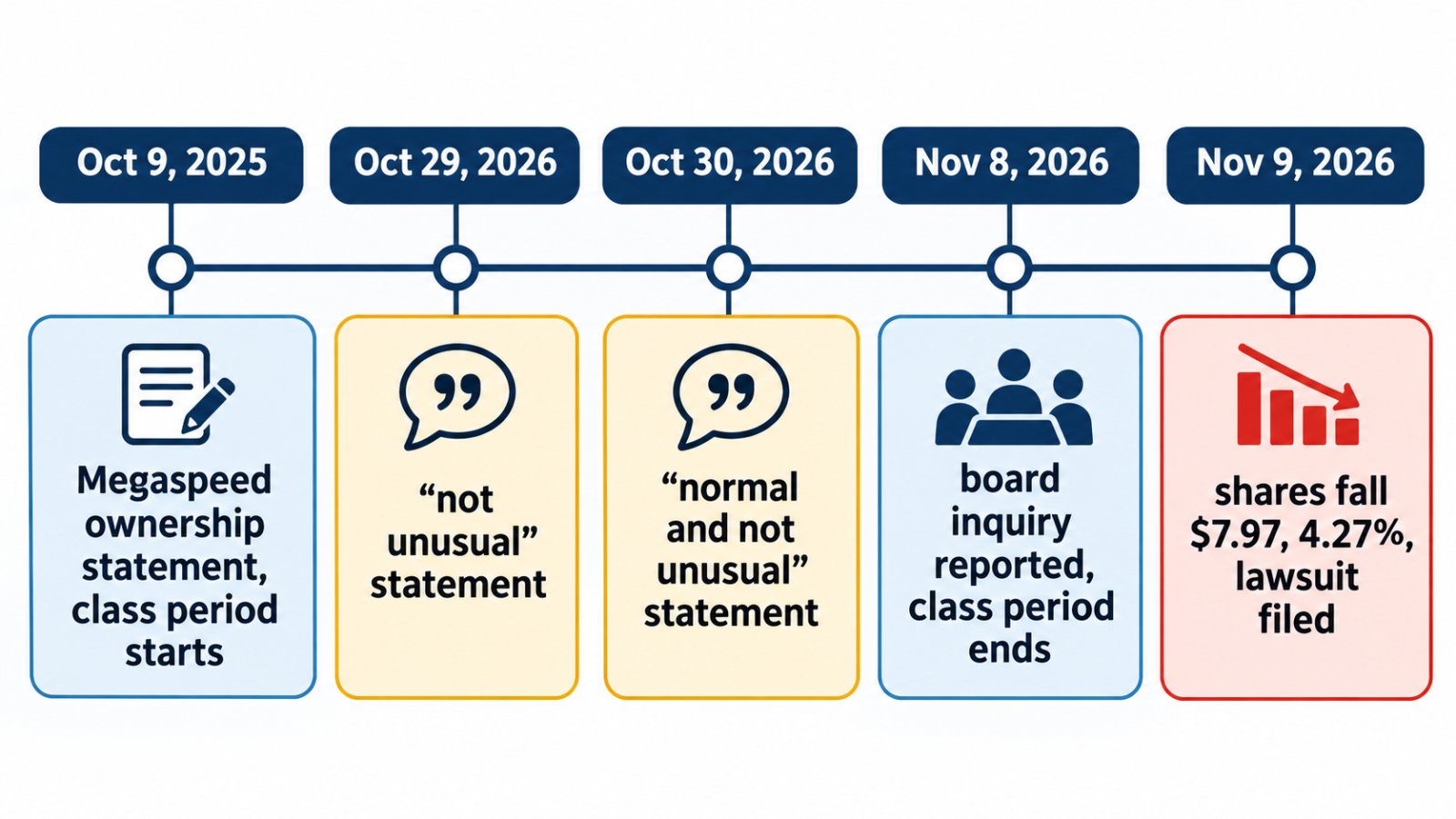
Nvidia and Huang spoke on the record several times before the board acted. The lawsuit is built on those statements. Here they are in order, up to the filing.
| Date | Who | What was said or done | Source |
|---|---|---|---|
| Oct 9, 2025 | Nvidia spokesman Rizzo | Said Megaspeed is "wholly owned and operated by a company based and headquartered outside China, with no China shareholders." The complaint challenges this statement, and the class period starts on this date. | PPC Land |
| Oct 29, 2026 | Nvidia | Said the export-diversion allegations "were thoroughly investigated and debunked last year." The NYT reported US intelligence surveilled Alice Huang. | CNBC |
| Oct 29, 2026 | Rizzo, to the NYT | "Jensen's interactions with Ms. Huang are not unusual or unexpected." This is challenged statement 3 in the complaint. | PPC Land |
| Oct 30, 2026 | Huang, to Bloomberg | Called the Megaspeed dealings "normal and not unusual." This is challenged statement 4. | PPC Land |
| Nov 8, 2026 (date of CNBC report) | Board | Opens an independent inquiry and says it has no reason to believe national security or Nvidia secrets were compromised. | CNBC |
| Sunday, per CNBC | Huang | Emails staff admitting an affair. | CNBC |
| Nov 8, 2026 | Complaint | The class period ends. | PPC Land |
| Nov 9, 2026 | Market; plaintiff | Shares fall $7.97 (4.27%) to $178.67. Kistenmacher v. NVIDIA is filed. | TechCrunch; PPC Land |
| Assumptions | US federal securities law. Prices are closing prices in US dollars as stated in the complaint and reported by PPC Land. The $186.64 prior close is implied by the complaint, not stated in it. The complaint's other challenged statements are not listed here. | ||
No source cited here shows any of these earlier statements being contradicted. Whether any of them was untrue is unknown.
What would a shareholder claim have to prove?
A falling price does not prove a claim by itself. Rule 10b-5(b) prohibits making "any untrue statement of a material fact," or leaving out facts needed to keep a statement from being misleading. The Supreme Court's Matrixx decision says plaintiffs must prove "a material misrepresentation or omission" and scienter.
TechCrunch quotes Stanford professor Bartlett: "I would definitely wager that there'll be a filing." TechCrunch reports that Bartlett calls the earlier statement misleading and sees "fraud on the market" as the likely theory.
The complaint, according to PPC Land, pleads no price reaction to the October 29 and 30 statements. The price drop it pleads is November 9.
| What the case turns on | Where the rule comes from | What the record shows so far |
|---|---|---|
| An untrue statement, or an omission that makes a statement misleading | Rule 10b-5(b); Matrixx | The complaint challenges statements from Oct 9, 2025 and Oct 29 to 30, 2026, among others. Whether any was untrue is unknown. |
| Materiality | Rule 10b-5(b) ("material fact") | Bartlett calls the earlier statement misleading (TechCrunch). Materiality is not addressed in the sources, and no court has ruled on it. |
| Scienter | Matrixx | Unknown. Nothing reported so far shows what the speakers knew when they spoke. |
| Reliance | Standard element of a private Rule 10b-5 claim | Bartlett sees fraud on the market as the likely theory (TechCrunch). Untested. |
| Loss causation | Standard element of a private Rule 10b-5 claim | The complaint pleads the $7.97 drop on Nov 9 but no price reaction on Oct 29 or 30 (PPC Land). Whether a court accepts the link is unknown. |
| Damages | Standard element of a private Rule 10b-5 claim | Unknown. |
| Assumptions | Federal claims under Section 10(b), Rule 10b-5 and Section 20(a). The case is in the Northern District of California. The class period runs Oct 9, 2025 to Nov 8, 2026. The last three elements are standard parts of a private Rule 10b-5 claim and are not drawn from the Rule's text or the Matrixx passage quoted above. | |
What does the complaint actually claim?
The case is Kistenmacher v. NVIDIA Corporation, No. 5:26-cv-13448. PPC Land reports that it was filed November 9, 2026, in the Northern District of California, with counts under Section 10(b) and Rule 10b-5 and under Section 20(a).
TechCrunch reports that the plaintiff is an individual investor and that the Rosen Law Firm filed the case. Other firms have announced investigations. Investors have 60 days from the first complaint to seek lead plaintiff status.
The class period, PPC Land reports, begins October 9, 2025, the date of the Megaspeed ownership statement, and ends November 8, 2026.
What should shareholders, index-fund holders and China watchers look for next?
- November 17: Nvidia's third-quarter earnings, CNBC reports.
- November 18: CNBC reports House chairs requested a closed-door briefing with lawmakers on this date. Whether it goes ahead is unknown.
- The Megaspeed ownership claim: the "no China shareholders" statement starts the class period. Anything that confirms or contradicts it bears on the first element in the table.
- The "debunked" line: CNBC reports Nvidia said the export-diversion allegations were investigated and debunked last year. Whether anything new comes out on that point is unknown.
- The board inquiry: its timeline is unknown.
- The lead plaintiff window: 60 days from the first complaint, per TechCrunch.
Index-fund holders may own Nvidia indirectly, through funds that hold it. How much of a given fund it makes up varies by fund.
Is this a Canadian case?
No. It is a US federal case under US securities law, filed in California. Nvidia trades in US dollars, so every price here is in US dollars, and the loss in loonies depends on the exchange rate that day. How the case treats holders outside the US is unknown. Canadian securities law is not covered here because no source on it was found.
If it were my money, I would treat the 4.27% as a dated fact rather than a ruling and check what Nvidia says on November 17 against the statements in the timeline above.

Kevin Marchand
For eleven years, Kevin kept the books for his parents' flooring store in Winnipeg. That's where he learned to read every invoice twice. Now he writes about money: budgets, mortgages, small business costs and what a rais...
View profileMore from Kevin Marchand
View all →
Where First-Time Buyers Paying All Cash Get the Money, and How to Bid Against Them
HDHP and HSA vs. No-Deductible Plan: The Break-Even Math for 2027 Enrollment

Leave a Comment