HDHP and HSA vs. No-Deductible Plan: The Break-Even Math for 2027 Enrollment
Is an HSA-qualified high-deductible plan cheaper than a no-deductible plan in 2027? It is when premium saved, employer deposit and tax saved beat the extra out-of-pocket. This works out bounds for healthy, moderate and high-use profiles from the 2027 IRS limits, plus a checklist.
views
$8,700 is the most a high-deductible plan that qualifies for an HSA can make a single person pay out of pocket for covered care in 2027. For family coverage the ceiling is $17,400. Both figures come from Rev. Proc. 2026-24, reported by the Journal of Accountancy. Premiums come on top of that.
Premiums are the other side of the trade. KFF's 2025 Employer Health Benefits Survey puts the average worker's share of a single-coverage premium at $1,440 a year. For family coverage it's $6,850. The 2026 survey has the family figure at $7,471.
Neither the ceiling nor the premium tells you on its own which plan costs less. That takes four amounts, and your employer holds two of them.
First, does the plan qualify for an HSA?
For 2027, an HSA-qualified plan needs a deductible of at least $1,750 for self-only coverage.
The plan's name doesn't settle that. KFF's survey uses its own lower threshold for calling a plan high-deductible: at least $1,000 for single coverage or $2,000 for family. A deductible that counts as high by one measure doesn't, on its own, show that a plan meets the IRS figure. Check the deductible against $1,750 and get HR to confirm HSA eligibility.
Where P, E, T and X come from
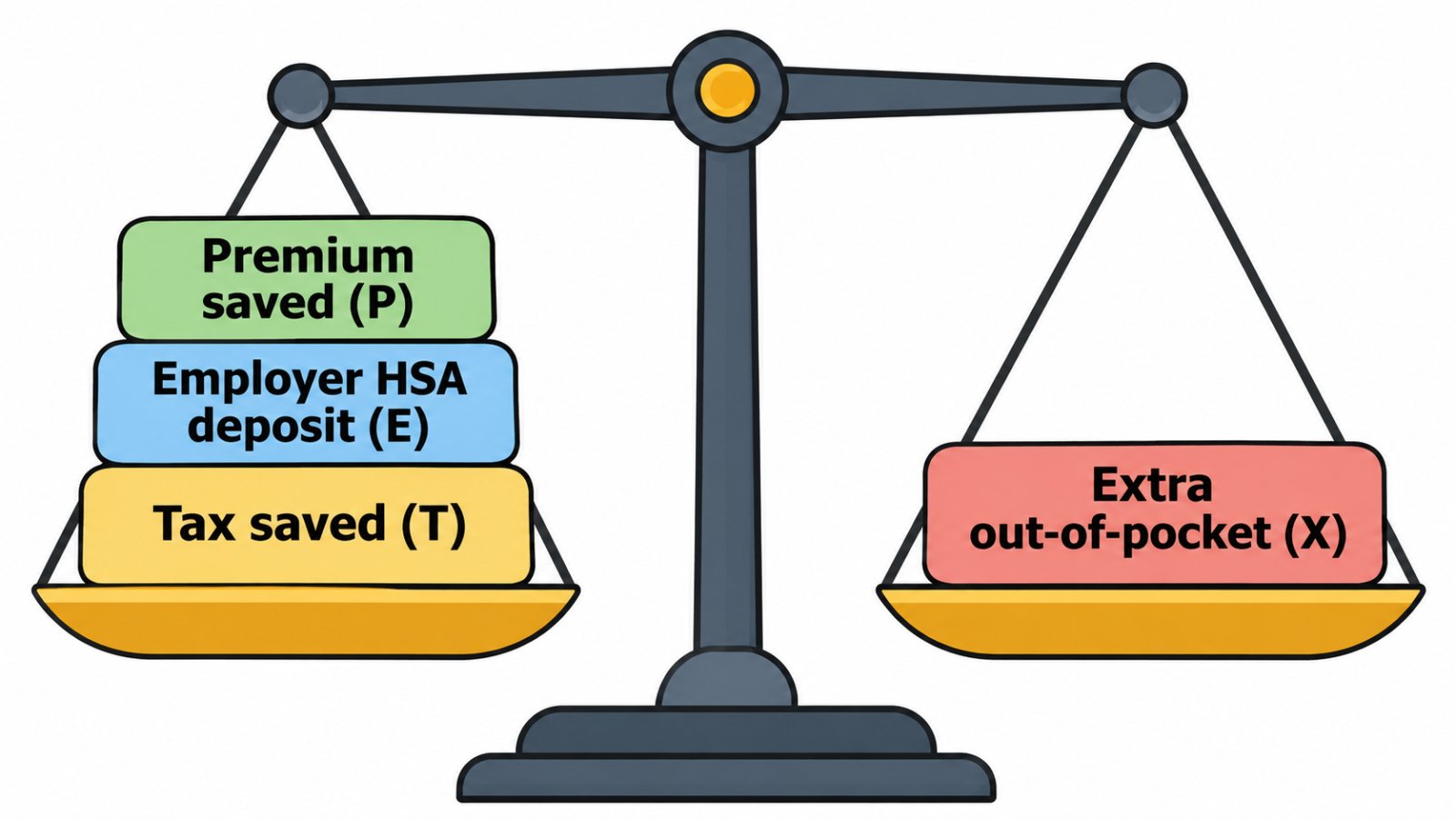
The high-deductible plan is the cheaper one for you if P + E + T is bigger than X. Use yearly amounts for all four.
- Premium saved (P). Take your yearly premium share for the no-deductible plan and subtract your yearly share for the high-deductible plan. If the sheet shows a per-paycheque amount, multiply it by the number of paycheques in your year. You pay premiums whether you see a doctor or not, so P doesn't depend on how much care you use.
- Employer HSA deposit (E). This is what your employer puts into the HSA, if anything. KFF notes that some workers in high-deductible plans receive these deposits, and that they can partly or fully offset the higher cost sharing. Under the IRS publication on HSAs, employer contributions aren't included in your income.
- Tax saved on your own contributions (T). This is your own contribution, C, times your marginal income tax rate. The 2027 contribution limit is $4,500 for self-only coverage and $9,000 for family, so that limit also caps T. The sources behind this piece don't say how an employer deposit interacts with that limit, so ask HR before you set C. They don't cover payroll tax either, so T here means income tax only.
- Extra out-of-pocket (X). Take what a given set of care costs you on the high-deductible plan and subtract what the same care costs on the no-deductible plan. This is the only one of the four that moves with how much care you use.
Two bounds follow from simple subtraction. X can't go above the out-of-pocket ceiling. What you pay on the high-deductible plan can't exceed it, and you can't pay less than nothing on the no-deductible plan. So X tops out at $8,700 for self-only coverage. P can't be bigger than your own share of the no-deductible plan's premium, because your share of the high-deductible plan's premium can't go below zero.
P and E settle the question, and neither one is public. Your employer sets both, and they show up on your enrollment sheet or come from HR. Without them this piece can't give you a yes or no. It can pin down the rest.
The IRS publication gives an HSA three tax breaks. Together they're what this piece calls the triple tax advantage:
- Employer contributions aren't included in income. That's why E goes in at its dollar amount.
- Contributions you make yourself are deductible. That's where T comes from.
- Distributions may be tax free if you pay qualified medical expenses. "May" is the IRS's word, and "qualified medical expenses" is the test.
Your own contribution, C, doesn't count as a cost in the sum. The money moves into your HSA instead of being spent, and amounts left at the end of the year generally carry over to the next. The sources here go no further than that carry-over rule. Whether an HSA balance can be invested, and on what terms, isn't covered, so it's left out of the math. Premiums only count as a difference. Whatever both plans would charge you anyway cancels out.
A US vs. Canada note: the closest Canadian match for T is the RRSP deduction. The difference shows up when the money comes out. RRSP withdrawals are taxed as income. HSA withdrawals for qualified medical expenses may be tax free.
Healthy, moderate, high-use: three readings of one plan summary
Each profile below is a definition, meaning a line on the plan summary you can look up. None of them is a forecast of your year.
Healthy profile: preventive care only. The IRS publication says an HDHP may cover preventive care without a deductible. "May" is the word to check on your summary. If both plans' summaries show preventive care at no cost to you, X is $0 and the high-deductible plan comes out ahead by the whole of P + E + T. Unspent HSA money generally carries over.
Moderate profile: covered care that uses up the deductible. On the high-deductible plan you pay the deductible. In 2027 that's at least $1,750 for self-only coverage. On the no-deductible plan you pay whatever copays and coinsurance its summary lists for the same care. X is the deductible minus those charges, so it can't be bigger than the deductible. If you pay the deductible from the HSA and the care counts as qualified medical expenses, the withdrawal may be tax free. This piece has no sourced 2027 minimum deductible for family coverage, so for family plans go by your summary.
High-use profile: covered costs reach the out-of-pocket maximum on both plans. In 2027 the high-deductible plan's maximum can't be more than $8,700 for self-only coverage or $17,400 for family. Your summary shows your plan's own figure. Call the no-deductible plan's maximum M. In this profile X is the HDHP maximum minus M, and the deductible no longer matters. It's also each plan's worst year on paper for costs that count toward the maximum. On the high-deductible plan that's the premium plus the maximum, minus E and T. On the other plan it's the premium plus M.
| Profile | HDHP out-of-pocket, per year | No-deductible plan out-of-pocket | Extra on the HDHP (X) |
|---|---|---|---|
| Healthy (preventive only) | $0 if the summary covers preventive care before the deductible | Its preventive-care charge, from its summary | $0 if both charge nothing for preventive care |
| Moderate (deductible used up) | The deductible: $1,750 at the 2027 minimum | Its copays and coinsurance for the same care: unknown | $1,750 minus those charges, so no more than $1,750 |
| High-use (both maximums reached) | Your plan's maximum, no more than $8,700 | Its maximum, M: unknown | Your HDHP maximum minus M, so no more than $8,700 minus M |
| P, E and T | The same in every profile. P and E are unknown here and come from your enrollment sheet and HR. T is C times your marginal rate, with C no more than $4,500. | ||
| Assumptions | Self-only coverage. 2027 IRS limits from Rev. Proc. 2026-24. The moderate row uses the $1,750 minimum deductible, and a higher deductible raises it. Tax bracket: your own federal marginal rate. State income tax treatment isn't covered by these sources. For family coverage: $17,400 maximum, $9,000 contribution limit, and no sourced 2027 minimum deductible. | ||
Before you hit submit
The sum above is a yearly total. It doesn't say when during the year the money leaves your account. The sources behind this piece don't cover timing, so ask two questions. Ask HR whether E arrives as one deposit or spread across paycheques. Ask the HSA provider how it handles a claim larger than the current balance.
- Check the high-deductible plan's deductible against the 2027 self-only minimum of $1,750, and get HR to confirm HSA eligibility.
- Write down your yearly premium share for both plans. The difference is P.
- Get E from HR, along with when it's deposited.
- Pick C, no more than $4,500 self-only or $9,000 family, and ask how your employer's deposit affects that room. C times your marginal rate is T.
- Confirm on the summary that preventive care is covered before the deductible.
- Pull both plans' out-of-pocket maximums. Your HDHP's maximum minus M is the high-use X.
- Price last year's claims under both summaries. That gives you an X based on care you actually used.
- Check that you have cash outside the HSA to cover the deductible.
For Canadian readers: everything above is US rules, including HSAs, the IRS limits and the IRS publication on HSAs. Provincial and territorial health plans cover medically necessary doctor and hospital services, so there's no deductible to pick for those. Canadian employer plans for prescription drugs and dental care do exist, but the sources behind this piece don't cover them, so they're outside its scope. Go check the Jets score.
If it were my money, I'd let last year's claims set X, take the high-deductible plan if P + E + T beat it, and get the high-use gap (my plan's maximum minus M, which can't be more than $8,700 minus M) in writing before signing.

Kevin Marchand
For eleven years, Kevin kept the books for his parents' flooring store in Winnipeg. That's where he learned to read every invoice twice. Now he writes about money: budgets, mortgages, small business costs and what a rais...
View profile


Leave a Comment