LinkedIn and Monster Pulled Over 1,000 Fake Job Ads, and Here Is How to Check Yours
LinkedIn removed close to 900 ads and Monster 600 after a CBC investigation tied them to a travel MLM whose information sessions asked for hundreds of dollars upfront. This piece covers how scams, ghost jobs and pipeline postings differ, and five checks to run before you apply.

views
About 900 ads on LinkedIn and 600 on Monster, roughly 1,500 job postings, were tied to one multi-level marketing company, the CBC reported. The jobs the CBC applied to were not what the ads described, according to its story as carried by Maharlika News. They led to information sessions that asked for hundreds of dollars upfront. The CBC's own headline put the count at over 1,000.
For anyone job hunting, the useful thing to work out is which kind of fake posting this was. A scam, a ghost job and a pipeline posting each want something different from you, and each costs you something different.
What did LinkedIn and Monster remove?
LinkedIn removed close to 900 ads connected to Evolution Travel, and Monster took down 600. That is the CBC's reporting as relayed by newsbeep, which also carries LinkedIn's word that the companies behind the ads will no longer be able to post jobs. Monster pointed to its "clear policies prohibiting misleading job postings and multi-level marketing opportunities."
The original CBC page was not available at the time of writing. A syndicated copy dated Nov. 12, 2026, on CINA Radio's site carries the "over 1,000" headline and a summary that puts the total at more than 1,500 misleading postings. Set against newsbeep's 900 and 600, the headline is the cautious figure. It is a floor, and 1,500 is the sum.
A LinkedIn spokesperson's statement, quoted by SFGATE, ran to one line: "These job posts were misleading and violated our policy, so we removed them." The ads offered remote jobs needing no experience, and SFGATE says they "were actually multilevel marketing schemes asking participants to funnel money into online programs."
The money side came out when the CBC applied to eight of the jobs. The applications brought back automated invitations to Evolution Travel information sessions, says the copy of the story on Maharlika News. The sessions asked for hundreds of dollars upfront plus a monthly subscription. An independent contractor agreement had a hidden $50 annual fee.
Put the two known charges side by side. The upfront ask was in the hundreds of dollars. The fee in the contract was $50 a year. The one exact figure is the smaller charge, and the larger one was asked for upfront. A job is supposed to pay you.
Evolution Travel is US-based and does not operate in Canada, the same copy reports. Its ads ran under other names, including Wanderwell Collective, Professional Travel Hub, Remote-Careers, Sky Land & Ocean Travel and Sunkissed Getaways. Maharlika News also carries the company's denial: it "consistently told their independent agents not to post job ads."
Three kinds of fake posting
Scams are run by criminals who want your personal information, CBS News explains. Ghost jobs are posted by employers, and by CBS's definition a post is fake "if the company has no intention of immediately filling the role."
The third kind is the evergreen or pipeline posting. Some employers keep job adverts live "to collect CVs and build up talent pools for potential future hiring," HRreview reports from a Greenhouse survey.
| Scam | Ghost job | Evergreen or pipeline posting | |
|---|---|---|---|
| Who posts it | Criminals after your personal information (CBS) | An employer with no intention of immediately filling the role (CBS) | An employer keeping the ad live to collect CVs (HRreview) |
| What it wants from you | Money, or personal details such as your bank account or SIN (Get Cyber Safe) | Your application | Your CV, for a talent pool and possible future hiring (HRreview) |
| Harm | Money and personal details. The CBC case asked for money the same way: hundreds of dollars upfront, a monthly subscription and a $50 annual fee | Time spent applying for a role the employer has no intention of immediately filling | Time spent on a CV sent for possible future hiring rather than an open role |
| How to tell | A request for money, bank details or your SIN, or pay that is extraordinarily high for minimal work (Get Cyber Safe) | The ad has been up for months (CBS) | The ad says it is collecting CVs for future hiring |
| Assumptions | Scope: Canada. US note: Evolution Travel is US-based and does not operate in Canada. The categories overlap. The CBC case was MLM recruitment that asked for money upfront, like a scam, and fits none of the three columns cleanly. Prevalence figures are from surveys: Resume Builder via CBS, Greenhouse via HRreview. | ||
Five checks before you apply
These ads offered remote work, and in Winnipeg a job with no commute is a job with no windshield to scrape in January. Get Cyber Safe, the federal government's online safety site, lists an offer that "promises extraordinarily high pay for minimal work or no prior experience" as a red flag. The five checks below are my own list. Where a source backs a step, it is named.
- Find the company's own careers page and look for the role there. If it isn't listed, or the name in the ad has no website at all, stop. In the CBC case, the ads ran under names such as Wanderwell Collective and Sunkissed Getaways, while the information sessions were Evolution Travel's.
- Check how long the ad has been up. CBS says posts that have been active for months "might be disingenuous."
- Look at the recruiter. Click through to the profile of whoever posted the ad or messaged you.
- Stop at any request for money or personal data before you have an offer.
- Search each company name with the word "scam," including the name on any information-session invitation.
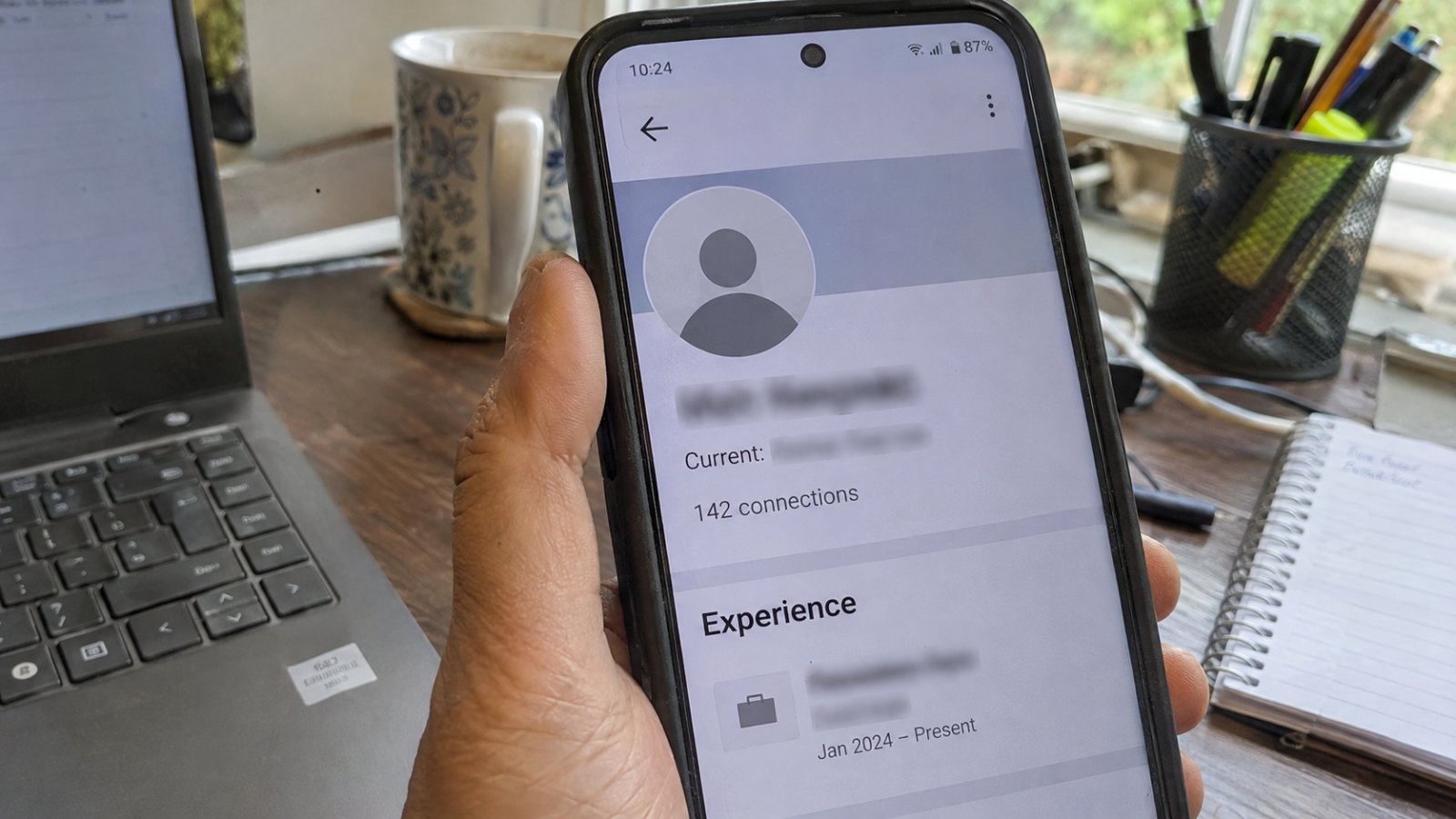
Step 3 matters most when the recruiter wrote to you first, because Get Cyber Safe lists unsolicited offers among its warning signs. A profile shows who the person says they are and who they say they work for. It cannot show that the job exists, which is what step 1 is for.
On step 4, Get Cyber Safe is blunt: "Legitimate employers will never ask for money to submit an application." It also warns against emailing details "like your bank account or social insurance number (SIN)." In the US the matching number is the Social Security number. The CBC story, in the Maharlika News copy, closes on the same rule: "the first rule is that a real employer never asks a job applicant to pay to be hired."
How common are ghost jobs?
In a Resume Builder survey reported by CBS, 40% of companies had posted a fake listing this year. CBS adds that three in 10 companies currently have fake listings on their sites or on job boards.
Greenhouse surveyed more than 1,200 employers. As many as 34% of UK roles posted online "were never actively being recruited for," by HRreview's account of that survey, and the figure was 22% across the three countries it covered.
What the reporting leaves open: the monthly subscription amount, how many applicants paid, the date of the CBS report and so the year its 40% covers, and what a ghost application costs in time.
If it were my money, I would never pay anyone to hire me, and I would treat a posting that has sat for months as a question, not a promise.

Kevin Marchand
For eleven years, Kevin kept the books for his parents' flooring store in Winnipeg. That's where he learned to read every invoice twice. Now he writes about money: budgets, mortgages, small business costs and what a rais...
View profileMore from Kevin Marchand
View all →
What Nvidia Shareholders Suing Over the 4.27% Drop Would Have to Prove

Where First-Time Buyers Paying All Cash Get the Money, and How to Bid Against Them
Leave a Comment