Why EV Fast Charging Slows After 80%, and What the Last 20 Points Cost in Minutes
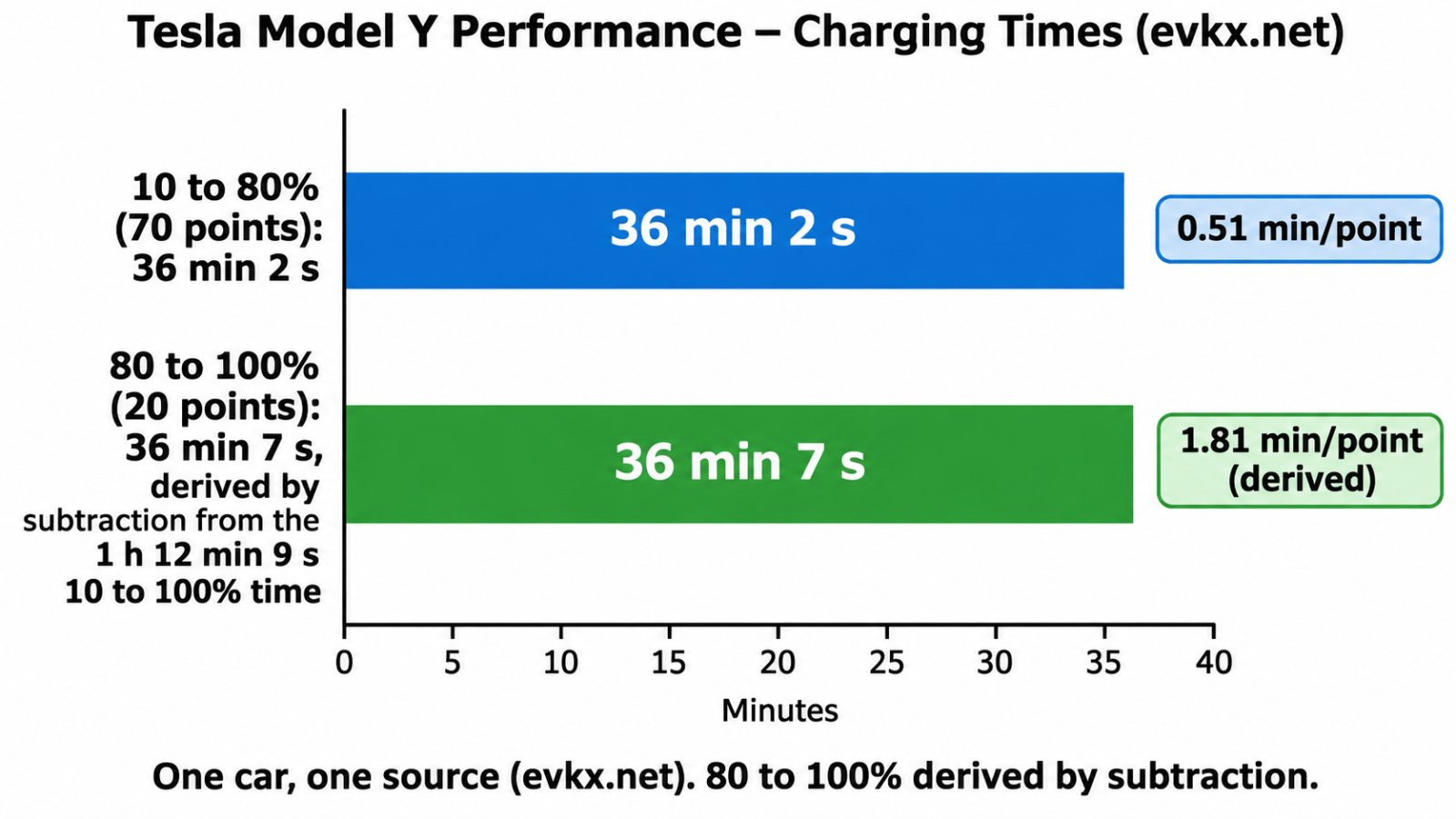
Fast chargers taper near full because of how lithium-ion cells charge. In evkx.net data, a Tesla Model Y Performance takes 36 m 2 s for 10 to 80% and about 36 more minutes for the last 20 points. It is the only car in these sources with a time above 80%.
views
Why does a fast charge slow down after 80%, and what does the slow part cost you in minutes? Engadget describes two separate things. A fast charger holds a constant current until the cells reach their voltage limit, then holds the voltage while the current falls. Separately, the car asks the charger to cut current past about 80%. The sources do not say the voltage limit and the 80% mark are the same point.
The cost shows up clearly in one car. In evkx.net's charging data for the Tesla Model Y Performance, 10 to 100% takes 1 h 12 m 9 s versus 36 m 2 s for 10 to 80%. Subtracting one from the other, the last 20 points take about 36 minutes.
Here is the catch: that Tesla is the only car in these sources with any time above 80%. The table below covers two models from three sources, and most of its 80 to 100% column is empty. The road-trip section further down rests on that one car's data.
Why does my charger slow down after 80%?
In the constant-current phase, the charger holds the current steady while cell voltage rises. Once the cells reach their limit, the charger holds the voltage and the current falls. Power is voltage times current, so with voltage held and current falling, the kilowatt figure drops. That last step is basic physics, not something the sources measured.
Battery University gives figures for lithium-ion in general. Cells with the traditional cobalt, nickel, manganese and aluminium cathodes typically charge to 4.20V per cell. A battery counts as full when it reaches that threshold and the current has dropped to 3% of the rated current. Battery University is describing lithium-ion cells, not EV packs, and the sources do not show that the 3% threshold applies to an EV fast charge.
Can't the car just push harder?
Engadget gives a reason. As the graphite anode fills, lithium ions take longer to settle into it. Forcing current in risks lithium plating, and Engadget says that is why cars taper the charge.
Battery University makes a separate point about lithium-ion in general: full saturation at the set voltage boosts capacity by about 10% but adds stress because of the high voltage. That figure is for the saturation stage of a lithium-ion charge. It does not tell you how much range the 80 to 100% stretch adds on a car, and the sources do not link the two.
Heat is the other obvious question. None of the sources here cover heat or how temperature changes the charge curve, so its effect is unknown.
How much time does the last 20% cost?
The rows come from different sources, so they are not like-for-like comparisons.
| Car | Source | 10 to 80% | 80 to 100% | 10 to 100% |
|---|---|---|---|---|
| Hyundai Ioniq 5 | Hyundai claim, 350 kW DC charger | 18 min | Not stated | Not stated |
| Hyundai Ioniq 5 | InsideEVs test | More than 18 min (20 to 80%: just over 15 min) | No data | No data |
| Tesla Model Y Performance | evkx.net | 36 m 2 s | About 36 min (by subtraction) | 1 h 12 m 9 s |
| Tesla Model Y Long Range | evkx.net | 32 m 42 s | Not in this data | Not in this data |
Of the three sources, only evkx.net gives a 10 to 100% time, and only for the Model Y Performance. The Hyundai figure is a claim for a 350 kW DC charger and stops at 80%. The InsideEVs test has no data above 80% either.
InsideEVs recorded the Ioniq 5 at about 130 kW by 79 to 80%. The sources do not compare that reading with the car's peak, so it does not show when the Ioniq's slowdown starts or how long its last 20 points take. Nothing here shows whether the Tesla's pattern holds for the Ioniq.
Should I unplug at 80% on a road trip?
On the Model Y Performance, evkx.net's figures put the last 20 points at about as long as the whole stretch from 10 to 80%. That comes from one car and one source.
There is even less data on arriving low. InsideEVs timed the Ioniq 5 at more than 18 minutes for 10 to 80% and just over 15 minutes for 20 to 80%. The gap between the two is small, and both figures are approximate. That is one comparison from one session on one car.
"Arrive low, leave at 80%" fits those numbers, but no source states that rule. The 80% half rests on one Tesla. The arrive-low half rests on one Ioniq session.
Whether 80% will get you to the next charger is a separate question. The sources give no route or range data, so when 80% is enough is unknown. They also do not measure how much time a stop costs beyond the charge itself.
Is stopping at 80% better for the battery?
None of the sources here test stopping at 80%. Battery University says lithium-ion does not need to be fully charged and that a partial charge is better.
A Geotab study says charging power is now the strongest operational influence on EV battery health. It links high-power DC charging above 100 kW to degradation of up to 3.0% a year. Geotab's press release does not say where in a session those high-power minutes fall, so it does not tell you whether unplugging at 80% changes that exposure.
Geotab also found that wide charge ranges did not raise degradation unless vehicles spent prolonged, habitual periods near full or near empty. For charging at home, that finding and Battery University's line on partial charges are all these sources offer. How home AC charging behaves above 80% is unknown from these sources.
Who should not stop at 80%
Anyone who needs more than 80% to reach the next charger should stay plugged in. That is common sense, not a finding. The sources give no range figures for any of these cars, so they cannot tell you when that applies.
If you drive something other than a Model Y Performance, do not base the habit on its numbers. They are the only 80 to 100% time in these sources, and the Model Y Long Range page in the same data has no time above 80%.

Karim Haddad
Is that discount real? Karim Haddad has tracked the same prices for years to find out. He runs the deals coverage out of Beirut.
View profileMore from Karim Haddad
View all →
Cottage Cheese vs. Cream Cheese for Protein: Calories, Sodium and the $2 Billion Boom
VXUS vs VEU vs SPDW vs EEM (Plus IEMG and VWO): Which International ETF Does What

Leave a Comment