Before You Install a Home Sauna: Electrical, Ventilation, Permits and Running Cost
Why the electrician's panel check comes before choosing a sauna: breaker sizing at 125% and where vendor tables disagree, plug-in infrared's limits, basement moisture, outdoor pads and trenching, permits, and hourly running cost, all from US sauna sellers' guides.
views
Price out the electrical work before you price out the sauna. Electric sauna heaters need a dedicated 240V circuit installed by a licensed electrician, according to Haven of Heat's outdoor cost guide, and that circuit may need panel space your house doesn't have. Any sauna indoors also puts heat and moisture into a room that has to be prepared for it, and a backyard model needs a pad to sit on and a trench back to the house. In the three outdoor examples that guide works through, the all-in total landed roughly $2,000 to $12,500 above the price of the sauna itself, so most of the uncertainty in this purchase sits outside the listing you are comparing.
Saunas are a long way from my usual beat of cameras, lenses and microphones, and the houses in this piece are American ones, wired to American codes and priced in dollars, because the guides I am working from are American. I should be plain about those guides: every source below is a company that sells saunas, so read them as interested parties rather than neutral references. They are still useful, mostly where they agree with each other, and what I can add is the reading I would give any spec sheet: what the thing demands of the room it goes into, and the order in which you will meet each cost if you plan properly.
The panel comes before the catalogue
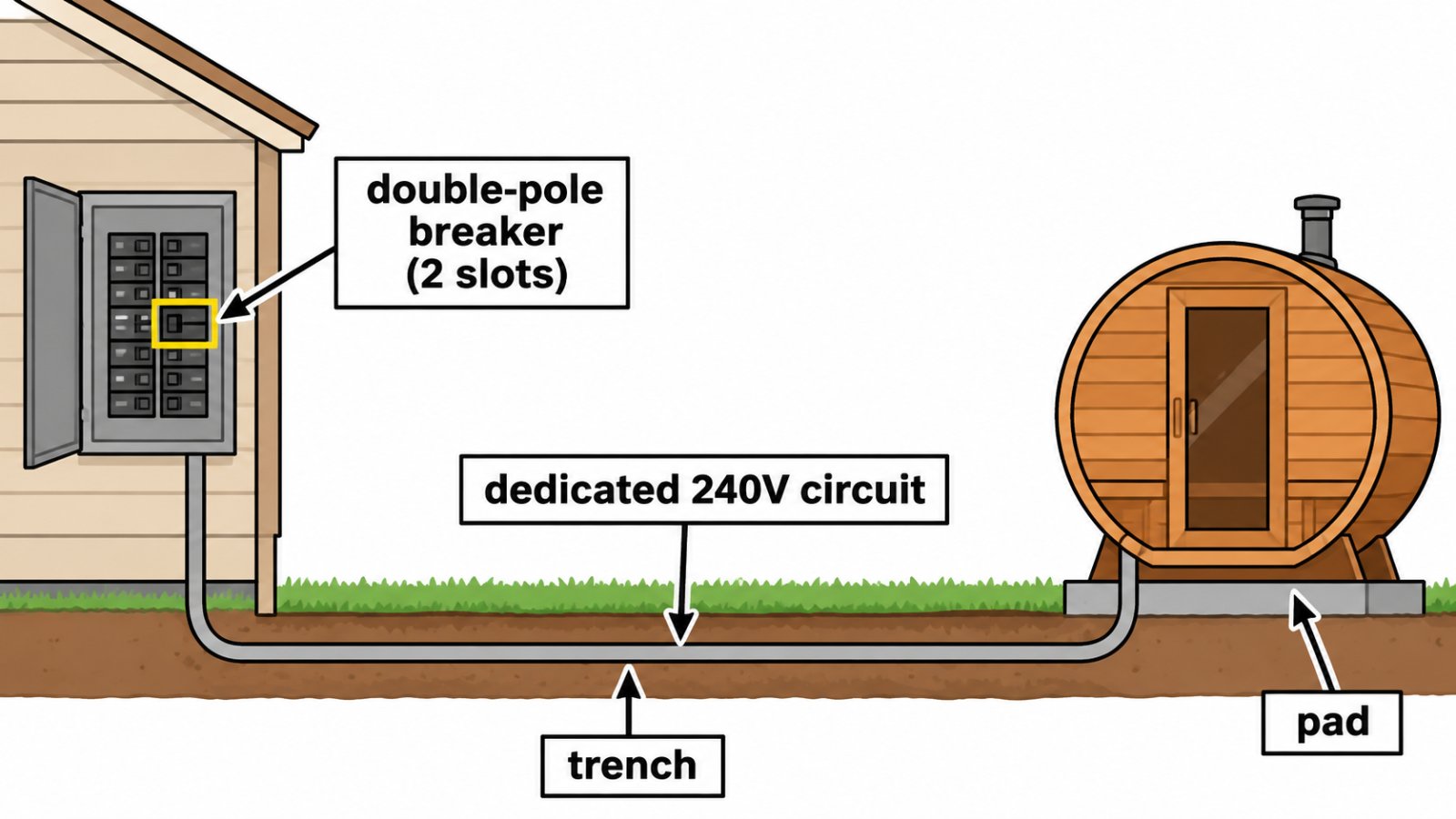
Two separate questions sit inside the breaker panel, and an electrician should answer both before you shortlist anything. The first is physical space. A 240V circuit needs a double-pole breaker, which Haven of Heat's wiring guide notes occupies two slots in your breaker panel. A double-pole breaker is two switches tied together, one on each side of the household supply, which between them give 240 volts instead of the 120 an ordinary outlet gets, and if the panel is already full there is nowhere to put it. The second question is capacity, which is harder to see. A panel is rated for a total current, the house already spends part of it on whatever else runs at the same time, and a sauna heater holds its full load for the whole session, so it can't be squeezed in on the hope that nothing else switches on. If the panel can't take it, the same guide puts a 100A to 200A upgrade at typically $1,500 to $4,000 including labor, materials and permit. That is the largest single item anywhere in this piece, and you can know whether you face it before choosing a sauna.
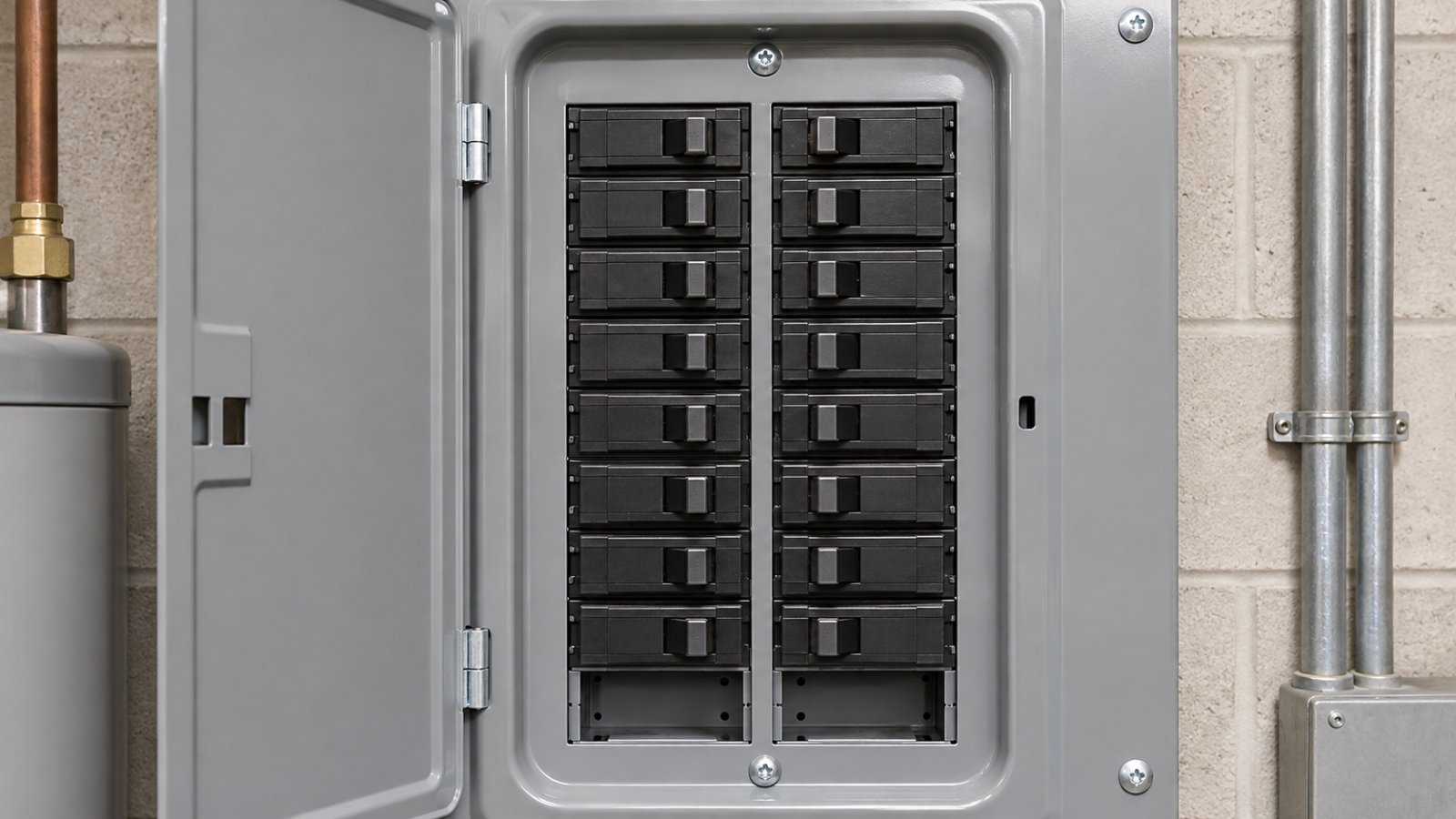
Breaker size follows from the heater. The rule in Haven of Heat's wiring guide is that the circuit must be sized at 125% of the heater's full-load amperage, the reasoning being that a heater draws its full current steadily for as long as the session lasts, and the margin keeps the breaker and wire from sitting at their limit for that long. What follows is my own arithmetic, not a code citation. A heater's current is its wattage divided by the voltage, and for a 6 kW heater on 240V that current, once the 125% margin is added, comes out just over 30 amps, more than a 30A breaker is rated for. The guide's table, written for copper NM-B cable (the flat sheathed cable often called Romex) on indoor runs of 50 feet or less, puts that heater on a 40A breaker with 8 AWG wire, which is consistent with the sum. The other rows fit the same way, each breaker sitting above the heater's current plus the margin: 4.5 kW gets a 30A breaker with 10 AWG wire, and 9 kW gets a 50A breaker with 8 AWG, or 6 AWG on long runs. AWG is the American wire gauge, and it runs backwards, so a smaller number means a thicker wire that carries more current and costs more per foot. The awkward part is that other vendor guidance puts a 6 kW heater on a 30A circuit, which my arithmetic doesn't support and the table contradicts. I wouldn't try to settle that from a blog post, including this one. The heater's installation manual states what its maker requires, the licensed electrician applies your local code to it, and the manual should be on the table when the quote is written.
Infrared cabins are sold on a different promise, and it is narrower than it sounds. A standard 120V/15A circuit delivers a maximum of 1,800 watts, and Haven of Heat's wiring guide lists compact infrared saunas at 1,000 to 1,800 watts. The guide states the 125% rule for heaters, so applying it here is my inference, but if it does apply, a cabin at 1,800 W already needs more than that circuit should carry continuously, while one near 1,000 W leaves real headroom. Either way, find out which outlets share the circuit before the cabin arrives, because anything else plugged in there counts against the same 1,800 W. Larger cabins are another matter. Peak Saunas' cost calculator lists infrared heater power from 1.8 up to 5.3 kW, and anything above 1,800 W can't run on that standard circuit at all. This is my opinion rather than the sources': the plug-in convenience is worth very little to most buyers. At the top of the compact range it depends on a circuit with nothing else drawing from it, and one size up it disappears, at which point you are calling an electrician anyway and should compare the infrared cabin with a traditional heater on equal terms, by running cost and by the room it needs, rather than by how easy the first day looks.
A basement in the house, or a barrel in the garden
Take the indoor case first: a sauna in a house basement, on a concrete floor. Salus Saunas' guide to basement and garage installs names moisture as one of the biggest concerns there and calls ventilation critical in both spaces. Peak Saunas' basement guide goes further and calls dehumidification essential rather than optional, with an exhaust vent near the ceiling and a vapor barrier beneath the sauna to stop moisture transferring from the concrete floor. A vapor barrier is a continuous sheet, usually plastic, that stops moisture moving through a surface. The floor matters too: Salus says to avoid carpet and wood floors and lists concrete, tile and vinyl as suitable, so if your planned spot is a finished room with a wood floor, the flooring change belongs in the budget. None of these sources puts a price on the dehumidifier, the vent route or the floor, so those are lines you will have to get quoted yourself, and the dehumidifier is one more appliance on the electricity bill.
Infrared cabins have an easier time downstairs, though not a free pass. Salus says they produce less moisture but still recommends proper barriers, and Peak's basement guide says infrared wood saunas tolerate 30 to 50% relative humidity. Relative humidity is how much water the air holds compared with the most it could hold at that temperature. If a hygrometer in your basement reads above that range before any sauna is involved, the dehumidifier is there for the cabin as much as for the room. Whichever type goes into the basement, Peak's guide also advises consulting your local inspector about electrical requirements such as GFCI protection. A GFCI, or ground fault circuit interrupter, is a breaker or outlet that cuts power very quickly if current starts leaking somewhere it shouldn't, such as through water or a person, and whether your jurisdiction wants one on a sauna circuit is a question for the inspector rather than the seller.
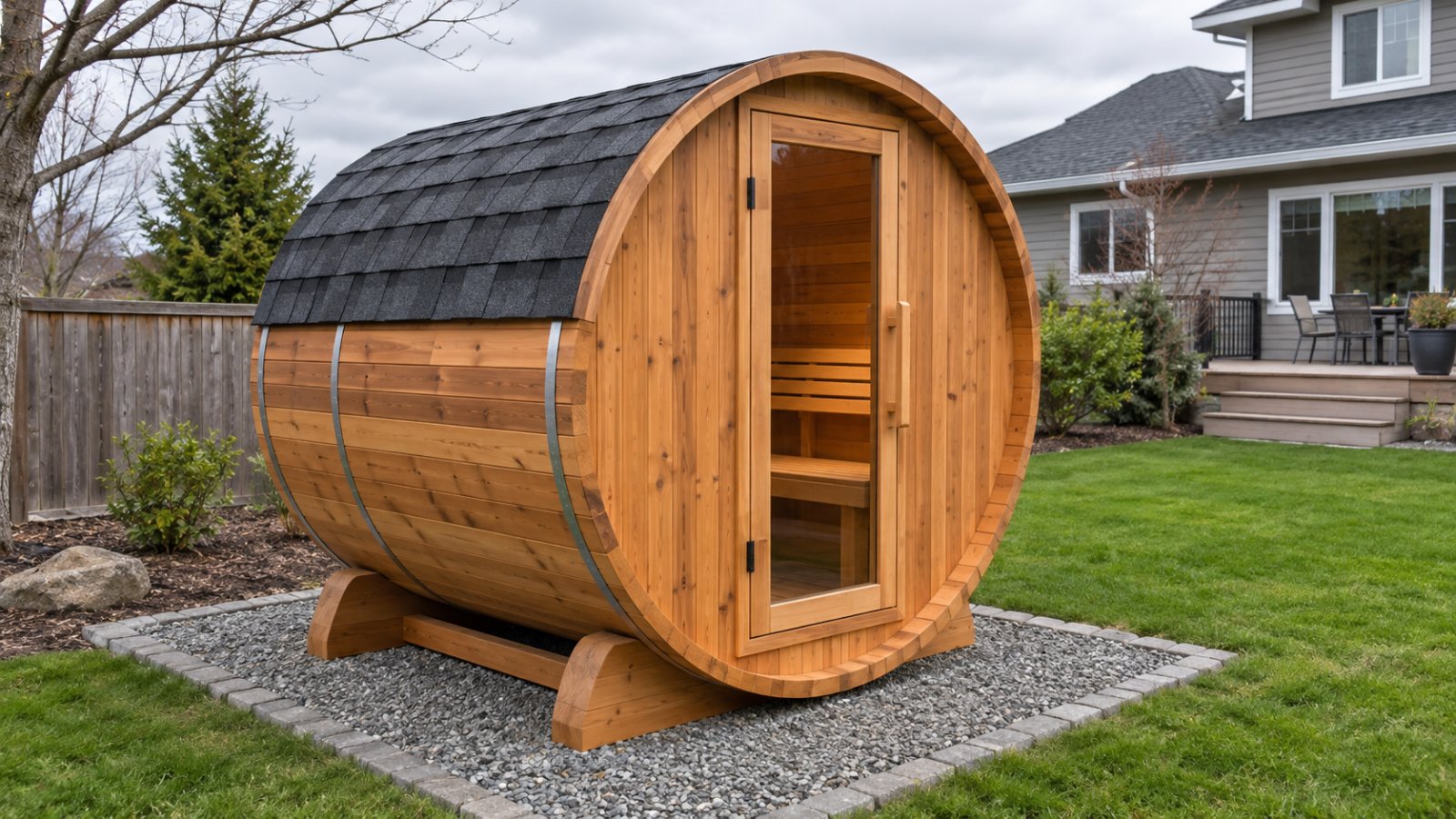
The backyard swaps the moisture question for a distance question. Haven of Heat's outdoor cost guide says barrel saunas sit on cradles and usually do fine on gravel or pavers, and its estimates as of October 2026 put a gravel pad at about $200 to $600 and a paver pad at $300 to $1,500. The same page says trenching a longer run often adds $500 to $1,500, and that larger heaters draw more amps and need heavier wire, which raises the cost of long runs. Don't read the wiring table above as a guide to this run. It covers indoor NM-B cable over 50 feet or less, so its long-run note about 6 AWG says nothing about a buried line out to the garden, and that wire is for the electrician to specify. Where the sauna goes is one of the few levers you have on the trench, so I would walk the site with the electrician before settling on a spot for the view.
It helps to set the outdoor lines side by side, because doing so shows which ones move. The pad runs from $200 at the gravel end to $1,500 for the dearest pavers, the trench from $500 to $1,500, and the permit from $50 to $500 (more on that below). A panel upgrade, if you need one, is $1,500 to $4,000 on its own, so the cheapest upgrade costs as much as the most expensive paver pad. These lines leave out things no source here prices, including the electrician's labor and the wire for the circuit itself, so they shouldn't be compared line for line with Haven of Heat's $2,000 to $12,500. What they do show is that the panel decides more than the pad does, and the panel can be checked before any money goes toward the sauna.
Permits, inspections and the running bill
For most buyers the permit matters more as a schedule than as a fee. Haven of Heat's outdoor cost guide says most jurisdictions require a permit when a traditional electric heater is involved, with permit and inspection costs of roughly $50 to $500. The permitting guide at soaknsweat.com says to expect building and electrical permits, with approvals typically taking 1 to 3 weeks, and to verify requirements with your city or county before ordering equipment. It also says to plan for a rough-in inspection before insulation and closure, and a final inspection after trim-out. Rough-in is the stage where the wiring is run but still visible, and if walls are closed before the inspector sees it, they may have to come open again, so for an indoor build that sequence needs agreeing with whoever builds the room before the sauna arrives on a pallet and everyone wants to finish. The same guide says permitting helps protect insurance coverage, warranties and resale value. It doesn't say what your insurer requires, and neither does any other source here, so a call to the insurer before installation is the only way to learn whether a new hardwired heater changes anything on your policy.
Running cost is easier to estimate, as long as you use your own tariff. A kilowatt-hour (kWh) is one kilowatt used for one hour, the unit your electricity bill charges by. Peak Saunas' cost calculator puts infrared at roughly $0.31 to $0.90 per one-hour session at the US average residential rate of about $0.17/kWh, a worst case that assumes full rated power throughout, or $9.18 to $27.03 a month used daily. The same calculator says traditional heaters are commonly 6 to 8 kW for a family-size room, and at that rate an hour at full power works out, by my arithmetic, to about $1.02 to $1.36. The calculator's own figure for traditional is higher, $1.50 to $2.50 or more per session. I can't account for the gap from what the sources say, and since a seller has an interest in how that comparison looks, I wouldn't adopt either number as yours. Multiply the heater's rated kilowatts by the per-kWh price on your bill and the hours you expect to use it, and remember that none of these figures includes the dehumidifier.
| Traditional (indoor) | Infrared (indoor) | Outdoor barrel (electric heater) | |
|---|---|---|---|
| Heater power | Commonly 6 to 8 kW for a family-size room | 1,000 to 1,800 W compact; calculator range 1.8 to 5.3 kW | Not given separately in these sources |
| Circuit | 240V, double-pole breaker sized at 125% of full-load amps | Compact units can fit a 120V/15A circuit (1,800 W maximum), at its limit; units above 1,800 W need more than that circuit* | Dedicated 240V installed by a licensed electrician |
| Panel and wiring | Two panel slots; 100A to 200A upgrade $1,500 to $4,000 if needed | Compact units may need no panel work if a clear circuit exists* | Two panel slots; trenching a longer run often $500 to $1,500; heavier wire for larger heaters raises cost |
| Moisture and ventilation | Basements: dehumidifier, exhaust vent near ceiling, vapor barrier underneath; ventilation critical | Less moisture, barriers still recommended; wood tolerates 30 to 50% RH | Not addressed in these sources |
| Floor or foundation | Concrete, tile or vinyl; avoid carpet and wood | Concrete, tile or vinyl; avoid carpet and wood | Gravel pad $200 to $600, pavers $300 to $1,500 (October 2026 estimates) |
| Permits | Building and electrical permits expected; approvals 1 to 3 weeks | Not covered separately in these sources; verify with city or county | Required in most jurisdictions with a traditional electric heater; $50 to $500 |
| Basement electrical | Ask local inspector about GFCI | Ask local inspector about GFCI | Not applicable |
| Electricity per hour at $0.17/kWh | About $1.02 to $1.36 at full power*; seller states $1.50 to $2.50+ | $0.31 to $0.90, worst case | Not given separately; depends on heater size |
* My inference or arithmetic from the sourced figures, not a seller's statement.
What I would check before paying a deposit
- An electrician at the panel: its amp rating, whether two slots are free, and whether an upgrade is needed.
- The heater's full-load amps and the breaker and wire size its manual requires, for a written quote that includes the run to the sauna's actual spot.
- The city or county permit office and local inspector: which permits apply, whether a basement circuit needs GFCI, and when the rough-in inspection falls.
- Quotes for the site: pad and trench outdoors, or flooring, vapor barrier, dehumidifier and a ceiling vent route indoors.
- The insurer.
- The sauna, last.

Hiroshi Tanabe
Hiroshi Tanabe shot wedding videos in Osaka for eight years. The cameras he bought back then, and some he regretted, are why he reviews them now. His tests of microphones and gimbals tend to run long, because he uses the...
View profile


Leave a Comment