Eight Ways Out of a Concentrated Stock Position, and What Each Costs in Tax
Eight ways out of a large single-stock position, from selling in slices to gifts, donations, exchange funds and collars. It covers what each costs in US federal tax and why the risk of waiting can outweigh what you save by spreading a sale.
views
Spreading a big gain over several tax years saves you a rate gap on part of it. Waiting to sell can cost you most of every dollar the stock drops. That's why I think most people holding one giant position are worrying about the wrong bill.
For married couples filing jointly, the 15% long-term band runs to $600,050 on 2025 figures. Only the part of the gain that a one-year sale would push past that line gets taxed at the higher rate. Meanwhile, every share you haven't sold yet stays fully exposed until the day you sell it.
Only two things make the gain go away for good: donating the shares, or holding them until death, when heirs generally inherit them at a stepped-up basis. Every other route pays the tax now, spreads it across years, moves it into someone else's bracket, or puts it off while you pay fees and accept lock-ups. Pick the trade-off you can live with, not the product the person across the desk happens to sell.
Scope: this is US federal tax law on IRS figures, written from Lagos. If you live outside the US or hold US shares from abroad, check how your own country taxes the sale first. I leave out state income tax and the qualified small business stock (QSBS) rules that apply to some startup shares. This is general information, not tax advice.
It's November, and two parts of this close for 2026 when the year ends: the $19,000 per-recipient gift exclusion, and any sale or charitable gift of shares you want counted in this tax year.
The rules that set the bill
IRS Topic 409 draws the first line. If you hold an asset for more than one year before you sell, the gain is long-term. Sell at one year or less and the gain is short-term, taxed as ordinary income at your regular rates instead of the lower long-term rates. Every RSU vest and ESPP purchase is a separate lot with its own clock, so a recent vest may not qualify yet.
The long-term brackets on that page are still the 2025 figures. For married couples filing jointly, the 0% rate covers taxable income up to $96,700 and the 15% band runs from there to $600,050. Above that, the rate is higher than 15%. Losses help less than people hope. Once your capital losses exceed your gains, only $3,000 of the excess can offset other income each year. On top of that sits the net investment income tax, an extra 3.8% once modified AGI passes $250,000 for joint filers or $200,000 for single and head-of-household filers. It's charged on the amount by which your MAGI exceeds the threshold, or on your investment income if that's smaller. A big sale can push you over the line even when your salary is well below it.
Step-up at death is the one rule here that wipes out a gain without you giving anything away. Shares you still own when you die generally pass to your heirs with a basis equal to their value at that point, so the gain built up during your life is never taxed. I don't count it as an exit, though. It only works if you carry the concentration risk for the rest of your life, and that risk is the whole problem.
Eight routes on one table
| Route | When the tax hits | Main cost | Lock-ups and limits | Who it suits |
|---|---|---|---|---|
| Sell everything now | This tax year, all at once | Largest single-year bill; any gain above the 15% band is taxed at a higher rate; 3.8% NIIT likely | None | Small positions, or gains that fit within one year's 15% band |
| Sell in tranches | Spread across several tax years | Same rates, timed to stay inside the 15% band; unsold shares stay exposed | Your own schedule, plus trading windows if it's employer stock | Large long-term gains where you can tolerate some exposure for a short while |
| Gift shares to family | When the recipient sells, at their rate, using your basis | You give up the asset | $19,000 per recipient annual exclusion in 2026 | Families with relatives in lower brackets you'd give money to anyway |
| Donate shares or fund a donor-advised fund | Never, on the donated shares | You give away the full value | Deduction limits of 20%, 30% or 50% of AGI may apply | People who already give to charity |
| Exchange fund | Deferred; your old basis carries into the fund units | Fees of roughly 0.85% to 1.5% a year, according to one trade-press report (unconfirmed); at least 20% of the fund in illiquid assets | Seven years; leave early and you get your original shares back | Holders with $500,000 to $1 million or more who won't need the money for seven years |
| Collar or prepaid forward | Deferred if the contract avoids a constructive sale; immediate if it doesn't | Upside you give up, contract costs, legal risk | Contract term; Section 1259 constructive-sale rules | Large holders who want protection or cash before they realize the gain |
| Direct indexing with loss harvesting | Harvested losses offset gains as you sell | Management fees; the estimated benefit isn't guaranteed | Wash-sale window; $3,000 cap on excess losses against other income | People selling in tranches who have new money for a taxable account |
| Dilute with new cash | None, because nothing is sold | Slow: the position shrinks as a share of your wealth, not in dollars | None | Anyone still receiving vests, bonuses or savings; works alongside every other route |
Selling: all at once, or in slices
One trade removes the risk completely. The price is that the whole gain lands in one tax year. A large gain runs past the 15% band into a higher rate and picks up NIIT as well. If the stock is a small slice of your wealth, or the gain fits under this year's 15% line, I'd sell and be done with it.
Selling in stages doesn't lower your rate. It splits the gain so each year's slice stays inside the 15% band. The cost is exposure, because whatever you haven't sold still moves with the stock. My view, and it's only an opinion: keep the schedule short. As the comparison below shows, one bad stretch can cost more than the spread saves, and every extra year is another chance for one.
Gifts to family move the gain into their bracket
Under the IRS gift tax rules, whoever receives your shares also takes your basis, so your low cost goes with the stock. What changes is whose rate applies when they sell: theirs, not yours. The 2026 annual exclusion is $19,000 per recipient. Once given, the shares are the recipient's to keep or sell as they choose.
Donating shares or funding a donor-advised fund
If you already give to charity, give stock instead of cash. The IRS says you can generally deduct the fair market value of donated property. That means the deduction is based on today's price, not your basis, and you never sell the shares yourself. Publication 526 says limits of 20%, 30% or 50% of AGI may apply, and it lists restrictions on donor-advised fund contributions. Read it before you move a large block. A donor-advised fund lets you take the deduction in your heaviest-gain year and pick the charities later.
An exchange fund is a seven-year commitment
You put your shares into a pool, other holders put in theirs, and you get back units in a diversified fund. No sale happens. Under current rules, you have to stay in for at least seven years. If you leave early you get your original shares back, which defeats the purpose. At least 20% of the fund has to be qualifying illiquid assets, typically real estate and often leveraged, so you take on exposure you didn't ask for. Traditional providers want $500,000 to $1 million in publicly traded stock. The tax is deferred, not eliminated, because your old basis carries into the units. On fees, one trade-press report puts them at roughly 0.85% to 1.5% a year. Treat that range as unconfirmed and get the exact figure from the provider in writing.
Collars and prepaid forwards: get a tax attorney first
With a collar, you buy a put below the current price and sell a call above it, often so the call premium pays for the put. Your downside gets a floor and your upside gets a ceiling. The risk is Section 1259. It treats you as having made a constructive sale of an appreciated position if you enter a short sale, an offsetting notional principal contract, or a forward contract on it. It defines a forward contract as one "to deliver a substantially fixed amount of property (including cash) for a substantially fixed price." Whether a particular collar runs into that rule depends on its actual terms, and only an attorney who reads them can tell you.
Variable prepaid forwards have their own track record. According to EY's write-up of the McKelvey case, Rev. Rul. 2003-7 held there was no sale and no constructive sale. The Second Circuit later held that modifying existing variable prepaid forward contracts triggered gain realization, reversing the Tax Court. Amending the contract can trigger the gain too, so don't sign or amend one without a tax attorney reading the paperwork.
Direct indexing: harvested losses to offset the big gain
You hold the individual stocks of an index instead of a fund, sell the ones that are down, and use those realized losses to offset gains as you sell your concentrated position. They pair well with a concentrated position because excess losses offset only $3,000 of other income a year, while a big position gives you plenty of gains to absorb them. Research by Chaudhuri, Burnham and Lo (2020), as reported by Morningstar, estimated the benefit at 1.10% a year before wash-sale constraints and 0.94% after costs. Plan around the lower figure, and treat it as an estimate, not a promise. Watch the wash-sale window, which runs from 30 days before a loss sale to 30 days after it.
Employer stock runs on a second calendar
With employer stock, tax isn't your only schedule. Many companies only let employees sell during open trading windows, and insiders may have to sell through a pre-arranged trading plan. I haven't sourced these rules for this piece, and they vary by company. Get your company's insider trading policy from the stock plan administrator or legal team before you plan a tranche around December.
One bad stretch can outweigh the tax you save
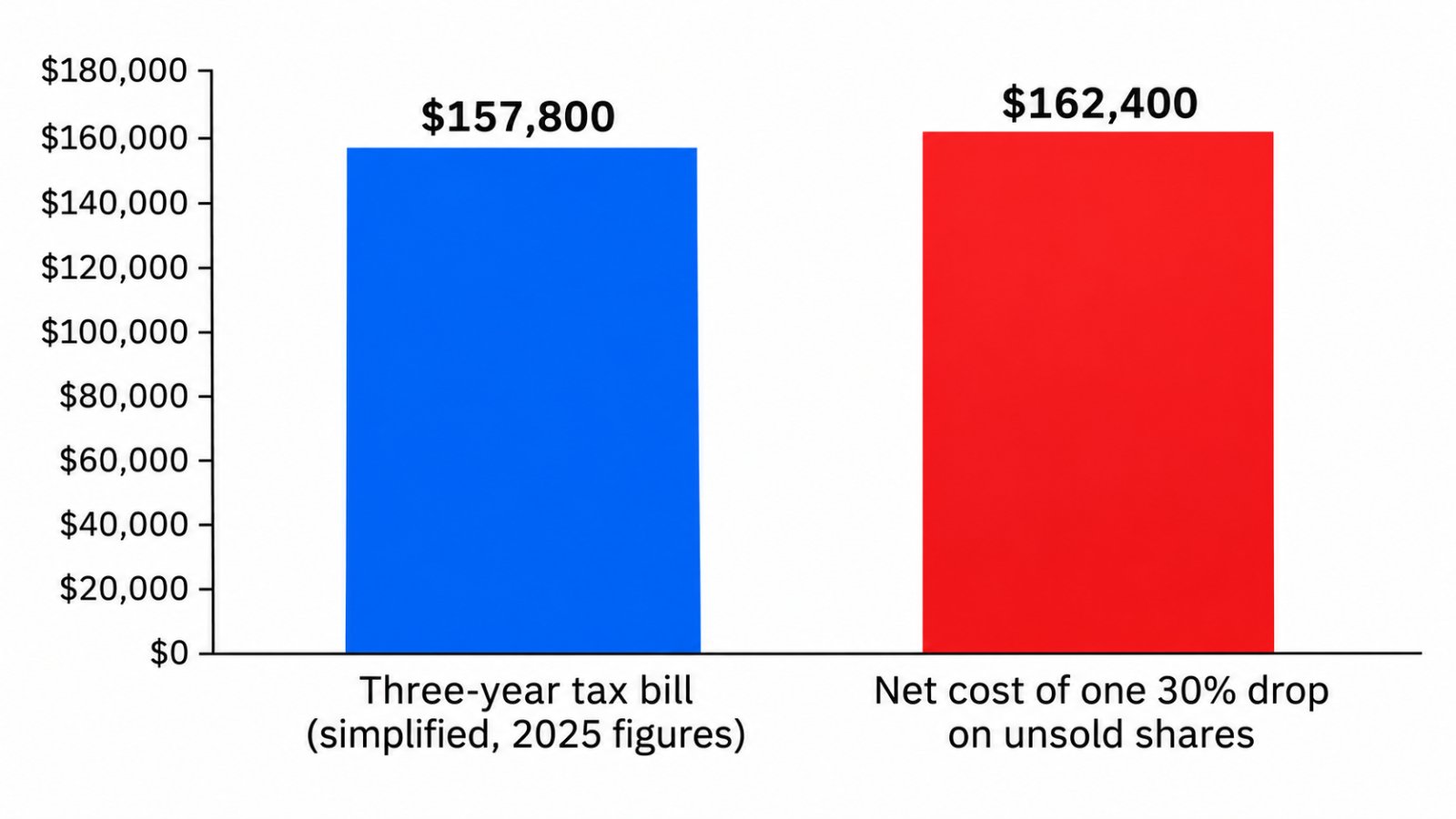
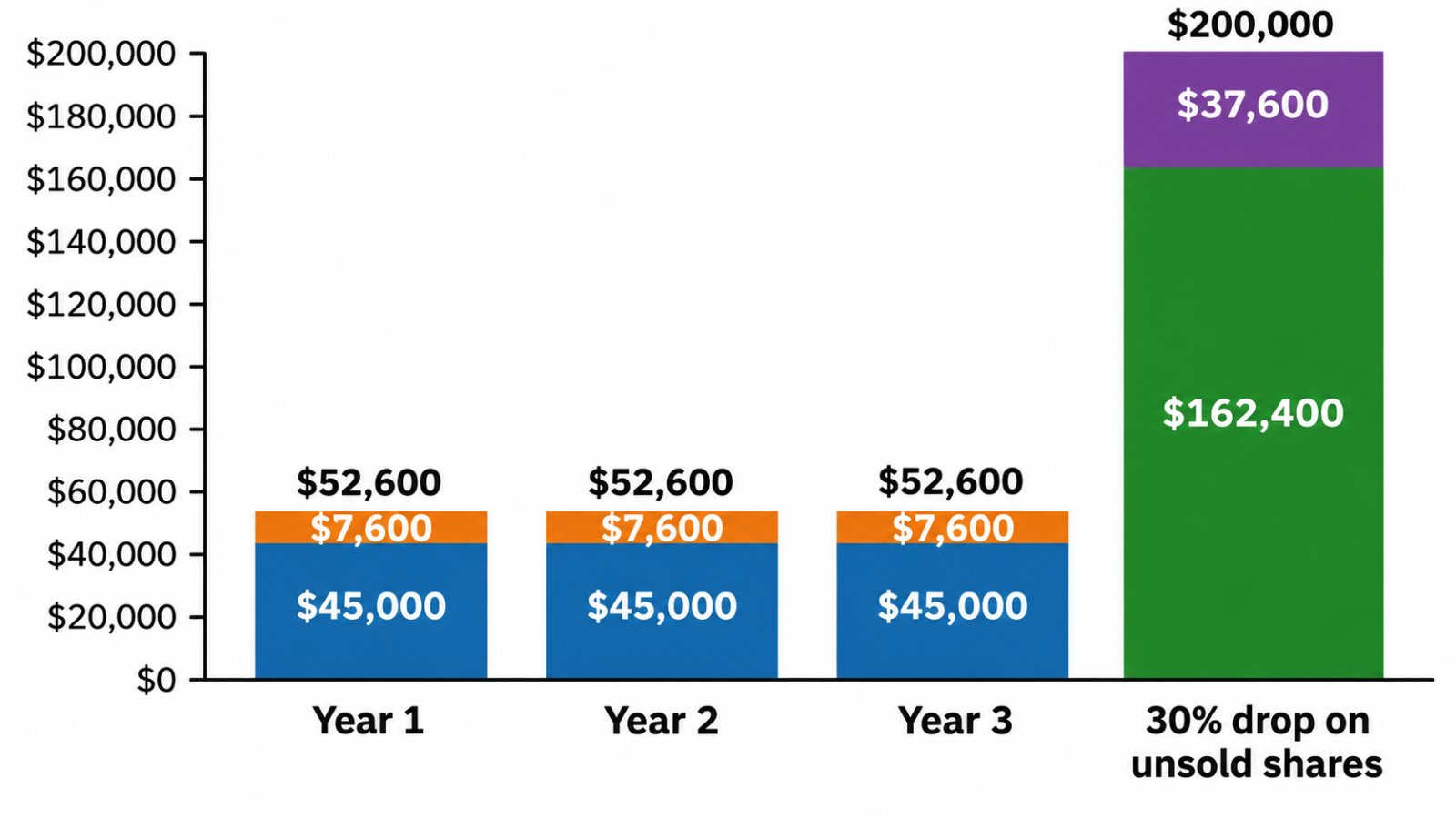
This comparison is simplified and uses the 2025 IRS figures. It assumes married filing jointly, every lot held more than a year, no state tax, and a gain stacked on top of other taxable income that already sits above the $96,700 top of the 0% band, so every dollar of gain is taxed at 15% or more. A real return can come out differently.
The measure I care about is cost per dollar moved out of the stock: how much tax you pay for each dollar of risk you get rid of.
What spreading the sale saves. Selling in tranches doesn't change the rate on any part of the gain that already fits under $600,050 of taxable income. It's 15% either way. The saving shows up only on the slice that a one-year sale would have pushed above that line, where the rate is higher than 15%. You also save a little NIIT, because a year with no sale wastes whatever room your income leaves under the $250,000 joint threshold.
What waiting can cost. Whatever you haven't sold still moves with the stock. If it falls before your next sale, the gain on those shares shrinks by the same amount. That isn't a deductible loss, just a smaller gain you haven't realized yet. While you're inside the 15% band and above the NIIT threshold, each dollar of value that disappears saves you 15% plus 3.8% in tax you no longer owe. The rest of that dollar is simply gone.
Put those side by side. Spreading the sale saves you a rate gap on a slice of the gain. A drop in the unsold shares costs you most of every dollar it takes. On a large position, one bad stretch between sales can wipe out more than the spread was ever going to save.
An exchange fund instead. Take the reported 0.85% to 1.5% at face value. That fee comes out of the account every year for seven years, and it buys diversification, not a smaller bill, so it doesn't compare directly with the tranche cost. The gain is only deferred, so the tax is still waiting at the end.
Adding a donation. Shares you give to a donor-advised fund in your heaviest-gain year are never sold by you, so you skip the 15% plus 3.8% you'd have paid selling them. You also get a deduction for their market value, subject to the AGI limits. The real cost is the shares themselves, which are no longer yours. It only makes sense if you would have given that much anyway.
Which route, for whom
This is my reading of the trade-offs above, not a rule from the tax code.
- Small position, or a gain that fits under this year's 15% line: sell it all now and move on.
- You already give to charity: give shares instead of cash, through a donor-advised fund if you want the deduction in your biggest-gain year.
- You'd give family money anyway, and they're in lower brackets: gift shares, up to $19,000 per recipient for 2026.
- Large gain, and you can tolerate some exposure: short tranches, ideally with direct indexing on new cash so harvested losses offset part of each year's gain.
- $500,000 or more in one stock, no need for the money for seven years, and comfortable with real estate exposure: look at an exchange fund, knowing the tax is deferred, not gone.
- You need downside protection or cash before you're ready to realize the gain: a collar or prepaid forward, with an attorney, or not at all.
- Still receiving vests, bonuses or savings: stop adding to the position and send new money into everything else. It costs nothing in tax and makes every route above work faster.
Do these before the year closes
- Pull your lot-level detail. Mark each lot as long-term (held more than a year) or short-term, since short-term gains are taxed as ordinary income.
- Work out this year's room. Topic 409 still shows 2025 brackets, so confirm the current figures. Then work out how much gain fits under the 15% ceiling and how far it pushes MAGI past the NIIT threshold.
- Check your trading window. For employer stock, find out whether a window opens before year-end or whether you need a pre-arranged trading plan.
- Make 2026 gifts before the year ends. The $19,000 per-recipient exclusion is for 2026.
- Bunch your giving. In your heaviest-gain year, a donor-advised fund contribution in shares puts the deduction where it does the most work.
- Track wash-sale windows. If you start direct indexing with new cash, log the 30 days before and after every loss sale.

Marcus Adeyemi
I build gaming PCs and test them until the fans give up. If a game stutters, I want to know why. Writing from Lagos.
View profile



Leave a Comment