Is an RGB LED TV Better Than Mini LED or OLED, and Worth It?
How RGB backlights differ from Mini LED and OLED, what eCoustics measured on Samsung's R95H (2,039 nits, 93.3% BT.2020), where OLED still wins, and whether $3,199.99 is worth paying.
views
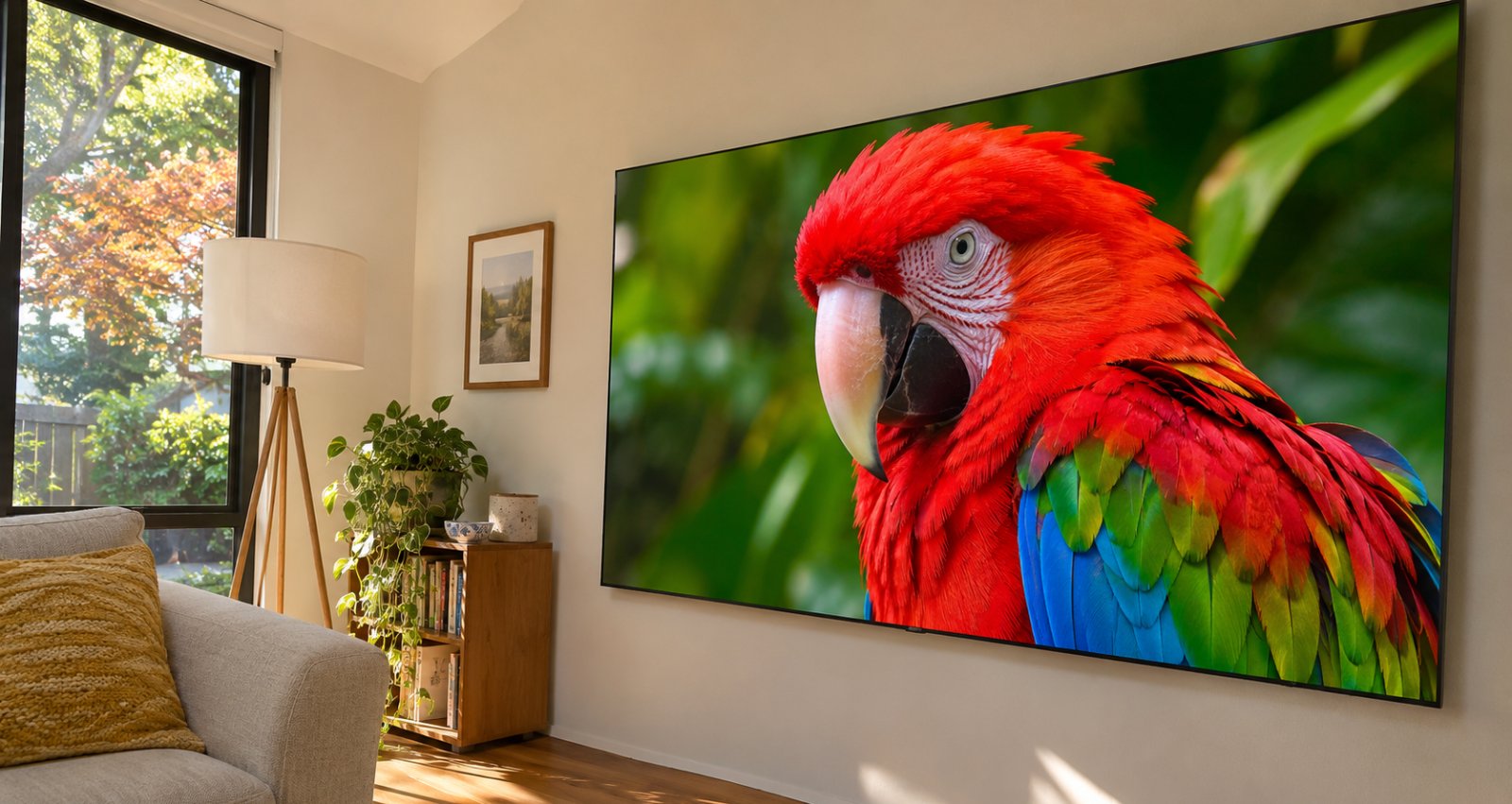
Is a $3,199.99 TV lit from behind by red, green and blue LEDs better than the OLED next to it on the shelf? Buyers have had to answer that since April 14, 2026, when Samsung's R95H Micro RGB lineup went on sale in the US, starting at that price for the 65-inch. An RGB LED TV is an LCD, like any Mini LED set, but its backlight makes its own color. eCoustics measured the R95H at a peak HDR brightness of 2,039 nits on a white 10% window in Filmmaker Mode and at 93.3% of BT.2020, and it says that color coverage exceeds flagship OLEDs, including Samsung's own S95H. OLED still has the deeper blacks. Ubergizmo says Micro RGB would be the better fit for brighter rooms, while OLED remains the more obvious choice for movie lovers watching in a dark room.
Is RGB really a new kind of TV?
It is a new backlight on a familiar kind of screen. Every LCD needs a backlight, because the liquid crystal layer can only let light through or block it and cannot make light of its own. In an ordinary Mini LED set the backlight is a single color, and filters in front of each pixel split it into red, green and blue. An RGB set moves the color into the backlight itself. Samsung describes its version as thousands of micro-sized red, green and blue LEDs that each give off light independently, so the light reaching the filters already carries color. The colored backlight is the whole difference from a Mini LED set, and Samsung's color claims rest on it.
Samsung calls its sets Micro RGB and separates them from RGB Mini LED, the wider category, by LED size: under 100 microns for Micro RGB, 100 to 400 microns for RGB Mini LED. Smaller LEDs let a maker fit more of them behind the panel, but both are backlights behind an LCD. Neither is Micro LED, where each pixel is its own tiny light and there is no LCD layer at all.
A 4K screen has millions of pixels, far more than the backlight's thousands of LEDs, so each LED lights a patch of many pixels. An OLED lights every pixel on its own and can switch a single one off completely. RGB's wins over OLED come from that backlight, and so do its losses, because the light can only be controlled patch by patch.
Does it beat OLED on color and brightness?
Samsung claims the R95H covers 100% of BT.2020, the widest color range in the HDR video standards, a result verified by VDE. Its buying guide puts OLED at 100% of DCI-P3 rather than BT.2020.
eCoustics measured 93.3% of BT.2020 and a peak HDR brightness of 2,039 nits on a white 10% window, both in Filmmaker Mode, the setting meant to show a film the way it was graded. The review says the 93.3% result still exceeds flagship OLEDs, including Samsung's S95H. A claim of 100% looks better on a box, while 93.3% is what a reviewer actually measured on the set. In Standard mode the 10% window test gave 1,908 nits.
The 10% figure is measured on a white window pattern covering 10% of the screen. On eCoustics' full-screen white pattern in Standard mode, the set measured 790 nits, well under its 10% window results.

Ubergizmo scored the R95H 9.5 out of 10, listed price as its only con, and called Micro RGB the more obvious choice for color intensity, high brightness and HDR impact.
Blacks and dark-room contrast still go to OLED
The limit is built into the design. What Hi-Fi's explainer on RGB Mini LED puts it plainly: "RGB Mini LED will never have the pixel-level contrast control of OLED." The category will not match OLED's black level or response times either. The cause is the same backlight, which lights patches of pixels while an OLED controls each pixel. Even Ubergizmo, after its praise, calls OLED the more obvious choice for black levels and dark-room contrast.
Blooming, the halo of light around a bright object on a dark background, is the side effect of any backlight that works in patches. Samsung says controlling each LED separately reduces it, and eCoustics saw very minimal blooming on high-contrast images. On an LCD the lit patch is still larger than a pixel, while an OLED has no backlight to spill.
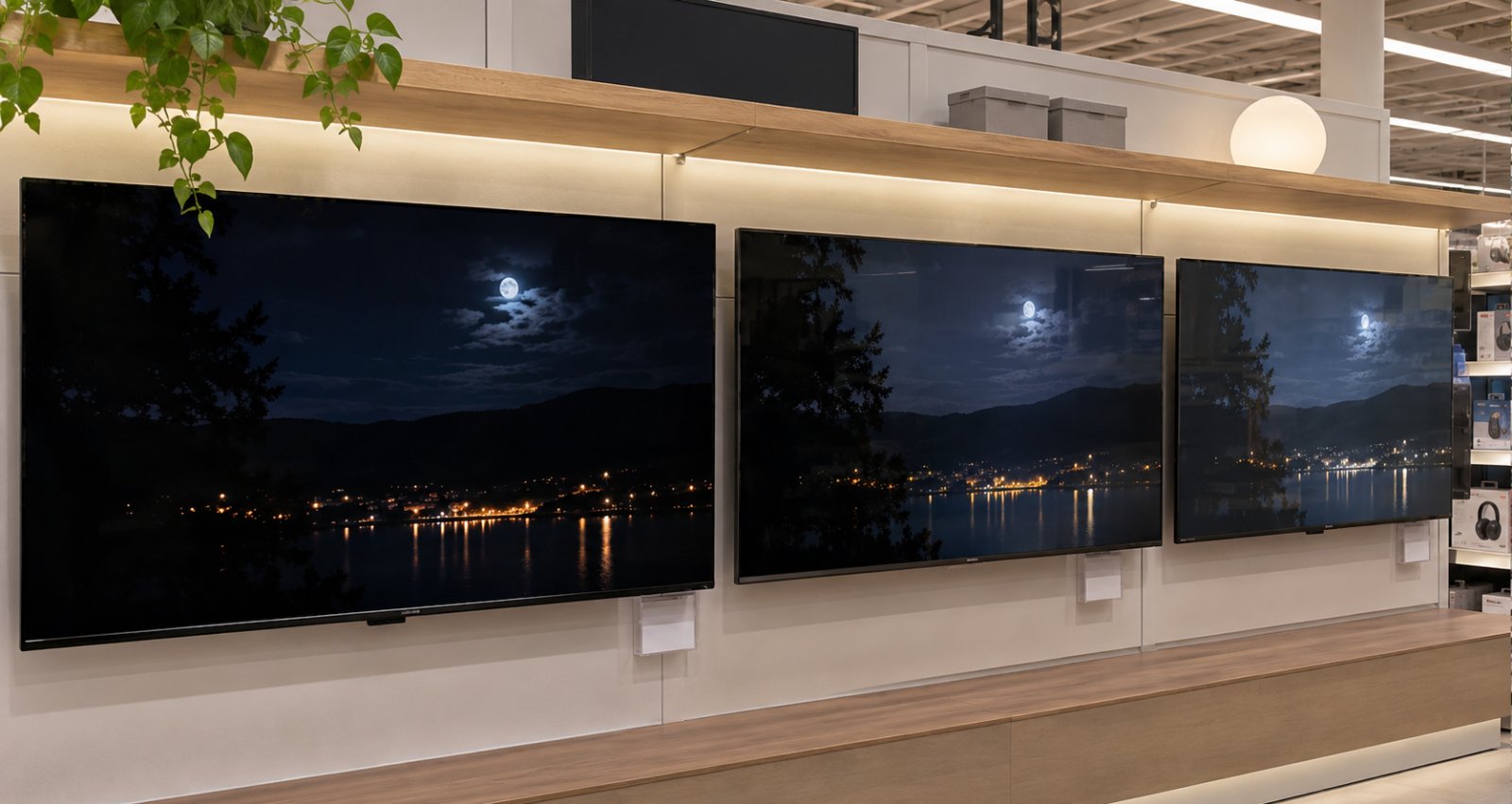
Reviews part ways on how much the rest of the picture suffers. What Hi-Fi's review of the R95H praised its balanced colors, but listed a picture lacking depth and solidity among its cons and judged its OLED counterpart the better TV. Tom's Guide headlined its review in favor of buying an OLED instead. Ubergizmo went the other way and found the R95H and the S95H OLED comparable in overall image quality.
The R95H also has no Dolby Vision, and eCoustics counted high grayscale error in Filmmaker Mode among its cons. Samsung's own black-level and grayscale certification covers the S95H and S90H, and the R95H is not on it.
Burn-in favors the RGB set more than the power bill does
OLED can burn in when the same image stays on screen for long periods. An RGB set is an LCD and carries no burn-in threat. What Hi-Fi lists the lack of any burn-in threat as an advantage of RGB Mini LED over OLED.
RGB Mini LED sets could also use less energy than an equivalent OLED. That saving covers the category as a whole and was not measured on the R95H. It is also an upper limit: What Hi-Fi says the category could save as much as 20 per cent.
Is $3,199.99 worth it over an OLED?
Samsung's US launch prices for the R95H are $3,199.99 for the 65-inch, $4,499.99 for the 75-inch and $6,499.99 for the 85-inch, sold on Samsung.com and at retailers including Best Buy. In the UK the 65-inch launched at £3,299, and in Australia at AU$5,299.
Ubergizmo says Micro RGB would be the better fit for brighter rooms. In a bright room, I think the R95H's brightness and color count for more than OLED's blacks, and burn-in stops being a concern. The 65-inch launched at $3,199.99, and eCoustics lists a discounted price of $2,999.99, which it says is still expensive for a TV. In a dark room, OLED's blacks and contrast give the better picture, and an OLED is the better buy.

Ondřej Malík
Graphics cards and PC hardware are the main subjects for Ondřej Malík. He also explains the chips inside ordinary laptops and what they mean for buyers.
View profileMore from Ondřej Malík
View all →
Recommended for you
More stories →
Six Kinds of Charging Cable Damage, Ranked From Bin Today to Bin Soon

Is It Safe to Give an AI Agent Full Disk Access on Your Mac?
iOS 27.3 Beta Puts a Daily Cap on Siri's Cloud Features, Raised by iCloud+
Leave a Comment