Over the Roth IRA income limit? Fix the excess by the filing deadline
The 2026 Roth IRA income limits, what the 6% excise tax costs, and three fixes for an excess contribution: removal with earnings, recharacterization, and a backdoor conversion after it, plus the 401(k) and HSA steps before December 31 that lower MAGI.

views
For 2026, the Roth IRA phase-out for a single filer ends at $168,000 of modified AGI.
A bonus can push a year's income past that line after the contribution is already in.
There are three fixes. Two of them share one deadline, the return due date with extensions included: take the excess out with its earnings, or recharacterize it so the year's money counts as a traditional IRA contribution. Either one, done in time, keeps the 6% excise tax off the excess.
The third, the backdoor, follows on from a recharacterization and has no income limit.
The line is modified AGI, not your salary
The test uses modified adjusted gross income. It starts from the AGI on your return, with some adjustments.
Salary alone says little about it. Pre-tax 401(k) deferrals come off before AGI is reached, and interest, bonuses and investment gains are added on.
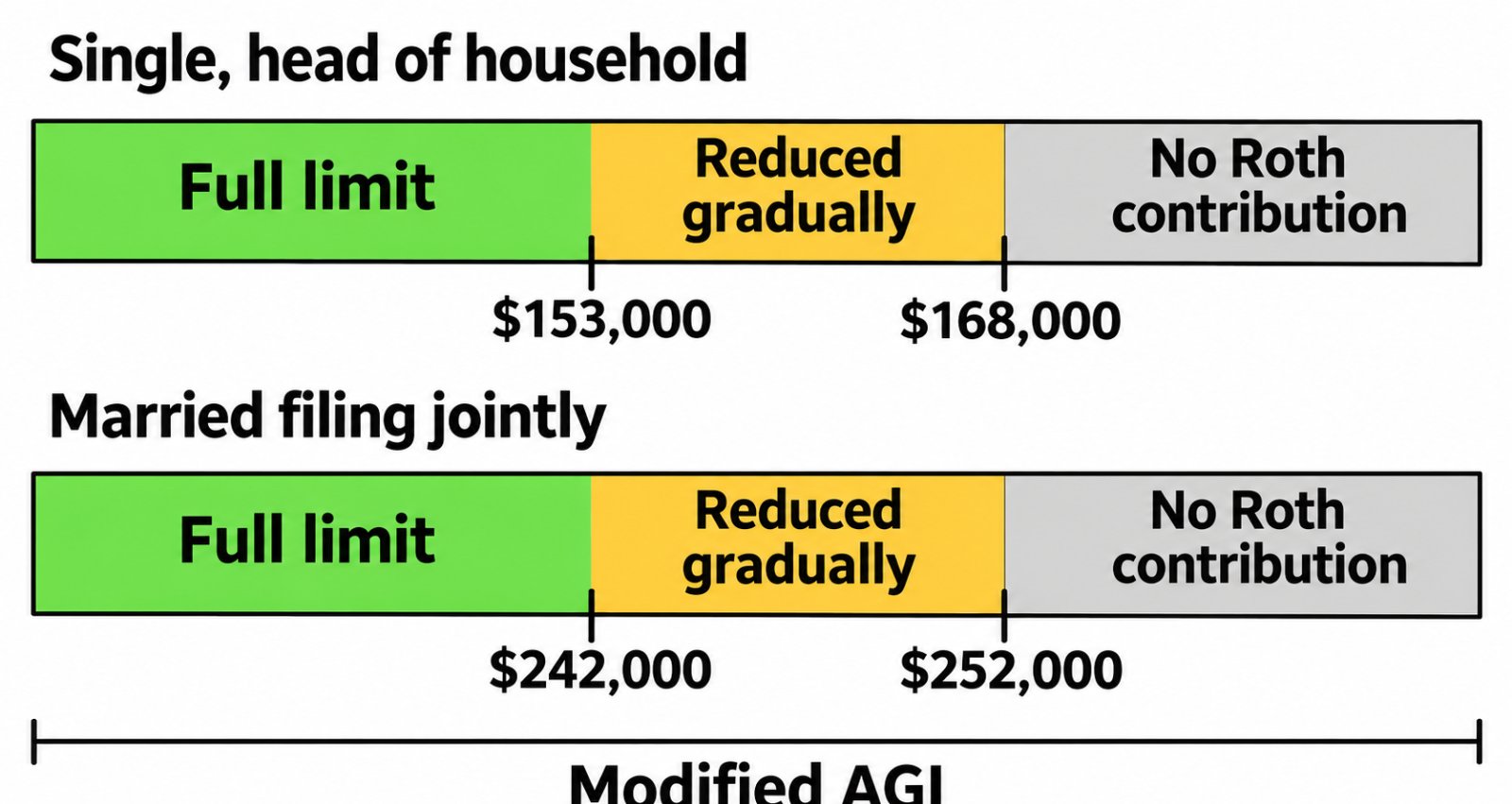
The IRS raised the 2026 phase-out ranges:
- Single and head of household: $153,000 to $168,000 (2025: $150,000 to $165,000)
- Married filing jointly: $242,000 to $252,000
Below the bottom of the range, the full amount is allowed: $7,500 for 2026, up from $7,000, or $8,600 at 50 and over, because the catch-up rose to $1,100 from $1,000.
Inside the range, the limit is reduced gradually, and IRS Worksheet 2-2 does the arithmetic.
Above the top of the range, no Roth contribution is allowed for the year, and everything put in is excess.
The year's income stays a forecast until the return is filed.
What the 6% excise tax costs, year after year
IRS Publication 590-A puts it in one line: an excess contribution "is subject to a 6% excise tax."
The tax applies again for each year the excess stays in the account, capped at 6% of the combined value of all your IRAs at year-end.
Taking the excess out by the return due date, extensions included, avoids it. For a 2025 excess, that means by April 15, 2026, extensions included.
An excess can also be applied to a later year, but only if that year's contributions are under the maximum for that year, and a penalty or additional tax may still apply.
Removing the excess and its earnings
Removal means asking the IRA custodian to send back the excess. What comes back is the excess plus the earnings on it, called net income attributable, or NIA.
The NIA is worked out from the whole account's balances, and Worksheet 1-4 in Pub. 590-A sets out the calculation.
Ascensus works through a sample calculation for a $3,500 contribution:
- Contribution to remove: $3,500
- Adjusted opening balance of the account: $48,758.21
- Closing balance of the account: $48,937.72
- Earnings on the whole account, closing minus adjusted opening: $179.51
- NIA on the contribution: $12.89
The NIA can be negative, which the IRS permits, and then the amount returned is smaller.
Recharacterizing, and the backdoor after it
Recharacterizing moves the Roth contribution, with its earnings, into a traditional IRA. The year's money then counts as a traditional IRA contribution.
It takes two steps: an election and a transfer.
A nondeductible traditional IRA contribution has no income limit, and a conversion from a traditional IRA to a Roth has none either.
That pair of moves is called a backdoor Roth, a term the IRS does not use. A conversion is treated as a rollover whatever method is used, so the money reaches the Roth as a conversion rather than as a contribution. The backdoor is reported on Form 8606.
The pro-rata rule, which Morningstar lists among the common roadblocks, blends all your non-Roth IRAs using their December 31 balances. The taxable share of a conversion follows the pre-tax share of that total.
How the three fixes compare
Removal and recharacterization have the same deadline: the return due date, extensions included. For a recharacterization, the election and the transfer must both be done by then. A recharacterization can also be elected late if the return was filed on time and the move is made within 6 months of the due date, not counting extensions.
Removal hands back the excess with its NIA. The 10% additional tax on early distributions does not apply to the returned contribution when the corrective distribution is made by the due date, extensions included, but the earnings are not covered by that exception.
Removal fits money that does not need to stay in an IRA this year.
Recharacterizing keeps the money, earnings included, in a traditional IRA. It fits when the money should stay saved, and it is where the backdoor starts.
The backdoor has no income limit at either step. Its cost is the pro-rata rule: the more pre-tax money sits in your other IRAs on December 31, the larger the taxable share of the conversion. It fits best when that pre-tax total is small or zero.
Lowering MAGI before December 31
Keeping MAGI under the line has to happen before the year closes.
Pre-tax 401(k) deferrals lower AGI, and so MAGI. The 2026 employee deferral limit is $24,500, up from $23,500, with an $8,000 catch-up at 50 and over.
Deferrals come out of paychecks, so only pay not yet received this year can be reduced.
HSA contributions also lower MAGI for anyone covered by an eligible high-deductible health plan. The 2026 HSA contribution limits are $4,400 for self-only coverage, up from $4,300, and $8,750 for family coverage, up from $8,550, plus a $1,000 catch-up at 55 or over.
Of everything here, these two are the better bargain: the money stays saved, and no excess ever needs measuring.
Once the year has closed, the cheapest fix is the one made before the return due date, extensions included.

Dana Zhaksybekova
I cover how markets and inflation change what households can save.
View profileMore from Dana Zhaksybekova
View all →

Recommended for you
More stories →
A spouse's general-purpose FSA can block your HSA contributions, and old ones can be fixed

Hedge funds are selling AI stocks. Should your index fund care?
The 1099 Line Moves to $2,000 for 2026 Payments, but Income Under It Can Still Be Taxable

Leave a Comment