VXUS vs VEU vs SPDW vs EEM (Plus IEMG and VWO): Which International ETF Does What
Six international ETFs compared by expense ratio and holdings. Why splitting SPDW with VWO or IEMG barely moves the fee, how South Korea can land in both funds or neither, what to check before adding VEU to VXUS, and why EEM is hard to justify for a long hold.
views
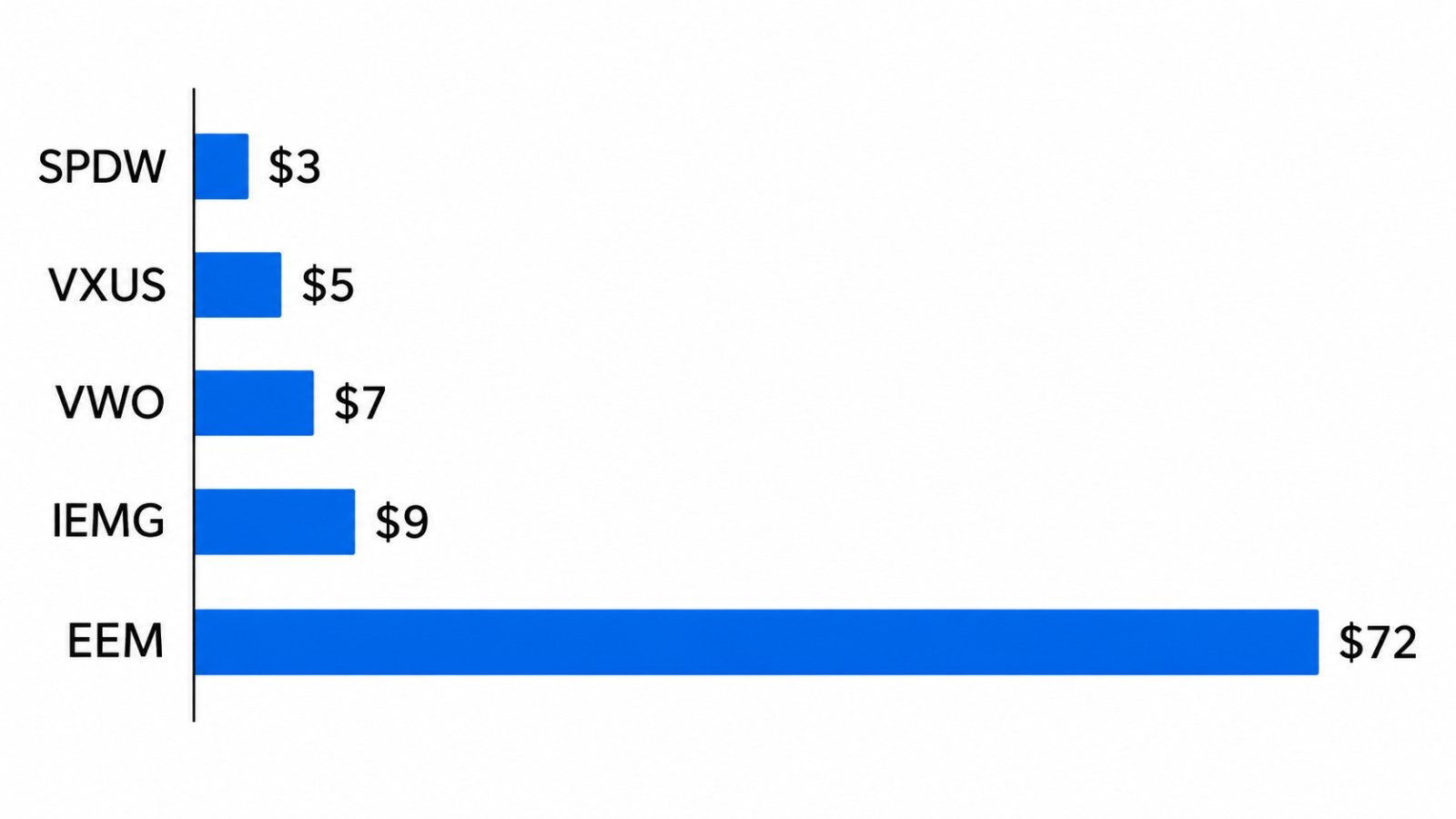
You already own a US fund. Which international ETF goes next to it, and does the ticker change what you pay? Start with the bill. Expense ratios on this list run from 0.03% for SPDW to 0.72% for EEM, and EEM is the outlier. The bigger difference is in what you own. VXUS holds developed and emerging markets in one fund. SPDW holds developed markets only. IEMG, VWO and EEM hold emerging markets only. VEU looks close to VXUS, but you need to check its fee and holdings on Vanguard's page.
| Fund | What it holds | Expense ratio | Holdings |
|---|---|---|---|
| VXUS | Developed and emerging markets, ex-US | 0.05% | 8,602 (January); 8,901 (Yahoo, November 2) |
| VEU | Japan weight and top holdings near-identical to VXUS | Unconfirmed (one aggregator shows an out-of-date 0.08%) | Unconfirmed |
| SPDW | Developed markets only; tracks the S&P Developed Ex-U.S. BMI Index | 0.03% | 2,436 (index: 5,471) |
| IEMG | Emerging only; counts South Korea as emerging | 0.09% | About 2,725 |
| VWO | Emerging only; leaves South Korea out | 0.07% | 6,146 |
| EEM | Emerging large and mid caps only; tracks the MSCI Emerging Markets Index (Net) | 0.72% | Unconfirmed |
The expense ratio is the yearly cost. It is the share of your balance the fund keeps each year, whatever the market does. The holdings counts move between dates. Yahoo puts SPDW at 2,420 holdings, and State Street says 2,436. Check the issuer page on the day you buy.
Size is a smaller question, but Yahoo's November 2 data gives VXUS $163.2B in assets against $41.1B for SPDW. In the emerging pair, Yahoo's comparison puts VWO at $141B and IEMG at $117B. I have no sourced asset figure for VEU or EEM.
One fund or a slice
If you want one international fund that covers both developed and emerging markets, VXUS does that for 0.05%. Broad coverage is not always that cheap. In the Motley Fool's comparison, ACWX, another broad international fund, charges 0.32% against VXUS's 0.05%. If ACWX is what you hold for international exposure, that comparison is worth reading. If you already hold VXUS, you don't need any of the single-region funds to get coverage. Adding one only changes the mix. Every other fund on the list either needs a partner or needs checking.
SPDW, in Yahoo Finance's words, "focuses strictly on developed economies." If it is the only international fund you hold, you own no emerging markets at all. The fund holds 2,436 stocks, and its index has 5,471. State Street describes the fund's aim as matching the index's total return before fees and expenses.
IEMG, VWO and EEM do the opposite. On their own they are narrower than the label suggests. In Yahoo's comparison of VWO and IEMG, the author says each puts at least 25% of its money into Chinese stocks. Check the current factsheet. If that figure still holds, at least a quarter of the fund depends on one country, so make sure that is a choice you mean to make.
Before you add VEU to VXUS
In Minafi's VEU vs VXUS comparison, Japan makes up 17.72% of VEU and 17.62% of VXUS, and the two funds share the same top holdings. On the only published comparison of the two, they look near-identical. That page also lists both at 0.08%, which is out of date for VXUS, so don't rely on it for VEU either. VEU's fee, holdings count and index are all on Vanguard's page. If you already hold VXUS, don't buy VEU until that page shows you what it would add.
Splitting into two funds barely moves the fee
The usual reason to split is cost: SPDW at 0.03% for developed markets, plus VWO at 0.07% or IEMG at 0.09% for emerging. SPDW is cheaper than VXUS. Both emerging funds cost more than VXUS. So the fee on the pair lands somewhere between SPDW's rate and the emerging fund's rate, and where it lands depends on how much you put in each.
| Option | Expense ratio | Where the cost lands |
|---|---|---|
| VXUS alone | 0.05% | One fee on the whole balance |
| SPDW + VWO | Between 0.03% and 0.07% | Closer to 0.03% the more you hold in SPDW |
| SPDW + IEMG | Between 0.03% and 0.09% | Closer to 0.03% the more you hold in SPDW |
| IEMG alone | 0.09% | Emerging only |
| EEM alone | 0.72% | Emerging large and mid caps only |
Here is the catch. The most a split can save against VXUS is measured in hundredths of a percentage point, and only if most of the money sits in SPDW. For that you have to rebalance two funds yourself, and you take on a country classification question that a single fund never raises.
Where South Korea ends up
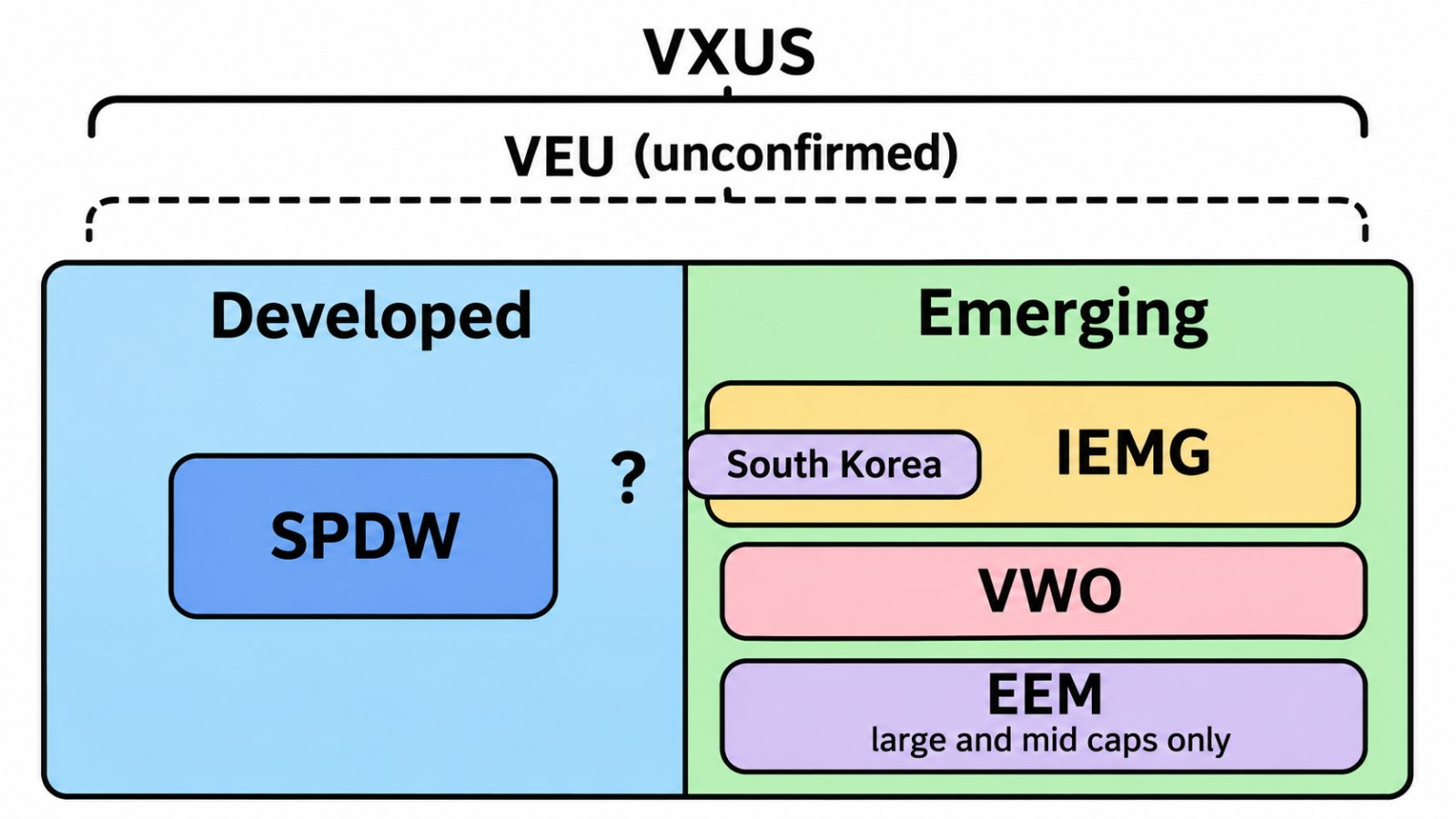
IEMG counts South Korea as an emerging market. VWO leaves it out. SPDW follows S&P's list of developed markets, so S&P's treatment of Korea decides what you end up owning. If SPDW holds Korea and you pair it with IEMG, you own Korean stocks in both funds. If SPDW doesn't hold Korea and you pair it with VWO, you own Korea in neither. Before you pick an emerging fund, open the country breakdown on State Street's SPDW page and look for South Korea.
Let that answer decide between VWO and IEMG. The fees are close: VWO charges 0.07% and IEMG charges 0.09%.
| Pairing | What you get | Check before buying |
|---|---|---|
| VXUS + SPDW | Developed markets in both funds, so a tilt toward developed | Whether you want that tilt |
| SPDW + IEMG | Korea counted as emerging in IEMG | Whether SPDW also holds Korea. If it does, you own it twice |
| SPDW + VWO | No Korea in VWO | Whether SPDW holds Korea. If it doesn't, you own none |
| VXUS + VEU | Near-identical Japan weight and top holdings in the one published comparison | VEU's fee, holdings and index on Vanguard's page |
| VXUS + EEM | A tilt toward emerging large and mid caps | Whether the tilt is worth EEM's 0.72% |
EEM's fee is the outlier
EEM charges 0.72% and IEMG charges 0.09%. Both are emerging market funds. EEM tracks the MSCI Emerging Markets Index (Net) and holds only large and mid-sized companies. No small caps. The fee gap is charged on your whole balance every year you hold the fund, so it grows as the balance grows. If you plan to buy an emerging fund and hold it for years, don't buy EEM. The fee is reason enough, and you pay it every year you hold the fund.

Karim Haddad
Is that discount real? Karim Haddad has tracked the same prices for years to find out. He runs the deals coverage out of Beirut.
View profileMore from Karim Haddad
View all →
Cottage Cheese vs. Cream Cheese for Protein: Calories, Sodium and the $2 Billion Boom

Statin or Not: Is a Calcium Scan Worth Paying For? What the CorCal Trial Found
Leave a Comment