Statin or Not: Is a Calcium Scan Worth Paying For? What the CorCal Trial Found
CorCal compared statin advice from a risk calculator with advice from a calcium scan. Events were 2.7% in both arms and adherence was higher with the scan. But noninferiority was not shown and the results are preliminary. Here is who should not pay for a scan.
views
Is a coronary calcium scan worth $100 to $400 of your own money when a risk calculator has already told you to consider a statin? Most insurers will not cover it, so the real question is what the fee buys. The CorCal Outcomes trial gives a partial answer. People whose advice came from the risk calculator were recommended statins more than three times as often as people whose advice came from a calcium score. Major cardiovascular events were 2.7% in both groups. Adherence was 62% in the scan group and 23% in the calculator group. But the trial did not show that the scan route is no worse, and the findings are preliminary.
What CorCal Outcomes compared
According to the European Society of Cardiology's press release, CorCal Outcomes randomly assigned 5,772 adults to one of two routes for statin advice. One used the pooled cohort equations (PCE), the standard risk calculator. The other used a coronary artery calcium (CAC) score. In both routes the clinician and patient made the final decision.
| Row | Risk calculator (PCE) route | Calcium scan (CAC) route |
|---|---|---|
| Who was in the trial | 5,772 adults, mean age 64, 51% women | |
| Who was excluded (from both arms) | Anyone with known heart or artery disease (ASCVD), diabetes, or earlier statin use | |
| How often a statin was recommended | More than three times as often | The baseline |
| Major cardiovascular events (death from any cause, heart attack, stroke, or a procedure to reopen an artery) | 2.7% | 2.7% |
| Hazard ratio, scan route vs calculator route | Reference | 0.99 (95% confidence interval 0.71 to 1.38) |
| Adherence to statins (measure not defined in our sources) | 23% | 62% |
| Average follow-up | 4.2 years | |
| Who made the final call | The clinician and patient, in both routes | |
| Was noninferiority shown? | No. Event rates were lower than expected, which reduced the trial's power | |
Events: 2.7% in each arm
Major cardiovascular events happened to 2.7% of patients in each group over an average of 4.2 years. The hazard ratio was 0.99.
The trial's definition of an event was broad. It counted death from any cause, heart attack, stroke and arterial revascularisation, meaning a procedure such as a stent or bypass to reopen an artery.
Here is the catch: noninferiority was not shown
CorCal was designed to show that the scan route is not meaningfully worse than the calculator route. It did not meet that test. ScienceDaily's report says the event rate was lower than expected, which reduced the study's power to detect a difference. The investigators are calling for a further trial.
The confidence interval shows how much is still open. Around the hazard ratio of 0.99, the 95% interval runs from 0.71 to 1.38. That range takes in both fewer and more events on the scan route, so the trial cannot say which, if either, is real.
Two more limits. Technology Networks reports that the findings are preliminary and not yet peer-reviewed. And 4.2 years of follow-up tells you nothing about how the two routes compare a decade out.
Fewer recommendations, higher adherence
The calculator arm was recommended statins more than three times as often as the scan arm. The sources do not report how many people ended up taking a statin in each arm. So the gap in recommendations cannot be turned into a gap in people treated.
The ESC release reports adherence of 62% in the scan-guided arm and 23% in the calculator arm, about 2.7 times higher. Our sources do not define how adherence was measured or who counts in the denominator. Take them as two reported rates and nothing more precise.
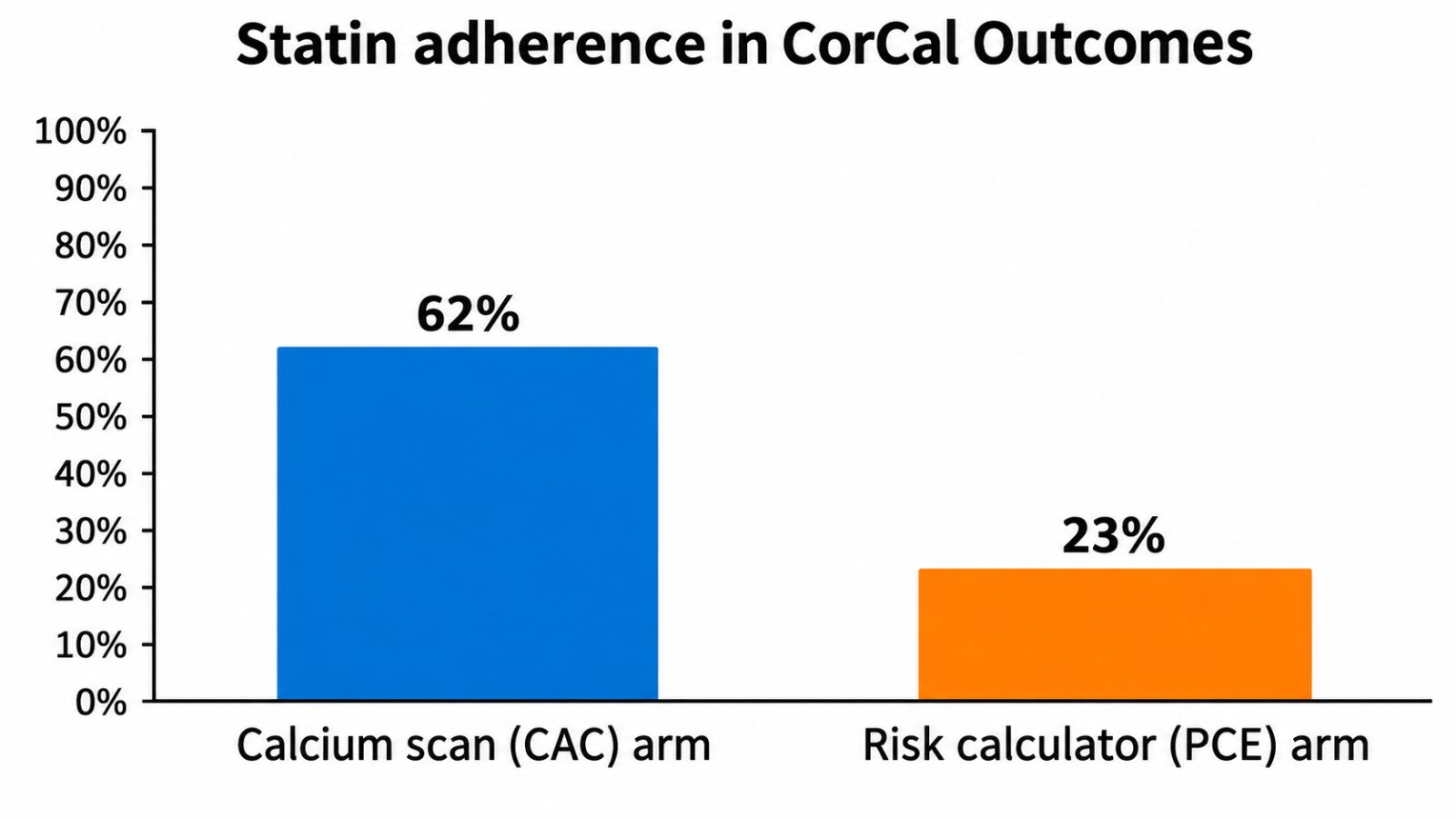
Why the gap? The trial does not say, and the investigators call the adherence result hypothesis-generating. Here is one hypothesis, ours and untested: a score taken from your own arteries may feel more concrete than a probability from a formula.
Reading a calcium score
A CAC scan is a CT scan that measures calcified plaque in the heart's arteries. The guidance below comes from a review published on PubMed Central and keeps to the review's own wording.
| CAC score | Guidance in the review |
|---|---|
| 0 | Very low event rates over a prolonged period, which the review calls a "warranty". Supports deferring a statin in selected patients |
| 1 to 99 | Individualised decision. Consider a statin, especially at 55 or older |
| 100 to 399 | Initiate or intensify statin therapy |
| 1,000 or more | Event rates approaching those of treated secondary-prevention cohorts, meaning people already being treated for established heart or artery disease |
Our sources give no separate band for scores above 399 and below 1,000. If your score lands there, ask your doctor how they read it.
The zero row has a qualifier worth noticing. The review limits deferral to selected patients, so ask whether you are one of them.
The ESC release also cites the ESC's 2025 focused update, which says high CAC "should be considered as a risk modifier in individuals at moderate risk or individuals around treatment-decision thresholds."
What a calcium scan misses
The same review says CAC does not detect non-calcified plaque and may therefore underestimate risk in selected patients. Your score reflects calcified plaque only.
Who this trial does not cover
CorCal excluded three groups from the whole trial, so neither the scan route nor the calculator route was tested in them:
- People with known heart or artery disease, such as a previous heart attack or stroke.
- People with diabetes.
- People who had used a statin before. If you take one now, this trial gives you no grounds for stopping it to get scanned.
Being left out of the trial does not tell you whether you need a statin. That question stays with your doctor.
A walkthrough for a borderline result
Why the decision matters at all: ScienceDaily's report on the trial quotes this line, where ASCVD means atherosclerotic cardiovascular disease.
"For far too many patients, the first symptom of ASCVD is a heart attack."
Here is one way to order the decision using only what the sources support. Every step ends with your clinician, as it did in the trial.
- Pin down your calculated risk. Ask whether you are at moderate risk or close to the treatment threshold. That is the group the ESC update names for using a high score as a risk modifier.
- Check the exclusions above. If you are in one of those groups, CorCal tells you nothing about a scan-first decision.
- Ask whether a score would change the recommendation. If your doctor says no, the scan buys you a number and nothing for this decision.
- Price it. Get a cash quote and check coverage, using the cost table below.
- If you scan, read the score against the review's bands. At 0, ask whether you count among the selected patients for whom deferral is supported, and when to reassess. The scan cannot see non-calcified plaque. At 1 to 99, expect a case-by-case discussion. At 100 to 399, the review's guidance is to initiate or intensify a statin. At 1,000 or more, the review puts event rates close to those of people already treated for established disease. Above 399 and below 1,000, our sources give no band, so ask.
- Decide with your clinician. Remember that CorCal did not show the scan route is as safe as the calculator route.
Who should not pay for the scan
This is my reasoning from the ESC wording, not a trial result. Skip the scan if:
- your doctor already places you well above the treatment threshold, which puts you outside the moderate-risk and near-threshold group the ESC update names;
- your doctor tells you the score would not change the recommendation;
- you would make the same choice whatever the score said.
What to price before you book
The $100 to $400 range comes from a single consumer guide on Healthline. That is a thin basis for a price, so use it only as a starting point and get a real quote. The same guide is our source for most payers not covering the scan and for coverage varying by state and plan.
| Cost item | Figure | Where it comes from |
|---|---|---|
| Calcium scan, cash price | $100 to $400 | Healthline (weak source) |
| Insurance coverage | Most payers do not cover it. Varies by state and plan | Healthline |
| A year of a generic statin | Not in our sources | Ask your pharmacist for a cash price for a year's supply |
| Scan fee against a year of statin | Your two quotes, side by side | Your own arithmetic |
The comparison I would make is the scan fee against a year of the statin you might start. Neither the trial nor our other sources give a statin price, so get one before you decide. While you are at it, ask your insurer whether a doctor's referral changes coverage.
Questions to take to your doctor

- Where exactly does my calculated risk fall? Am I near the line where treatment is advised, or clearly above it?
- Would a calcium score change what you recommend? If it wouldn't, why pay for one?
- If my score is 0, am I one of the selected patients for whom waiting is reasonable, and how long would you wait before reassessing?
- Is there anything in my history that makes a zero less reassuring for me?
- If my score is high, what dose would you start with, and what would we check at follow-up?
- Do I fall into any group CorCal excluded, such as diabetes or a previous heart event?
- What would a year of the statin you would prescribe cost me, and how does that compare with the scan price?
FAQ
Did CorCal prove the scan is as good as the calculator?
No. Event rates were 2.7% in both arms, but the noninferiority test was not met.
Why did more people in the scan group stay on statins?
The trial does not say. The investigators call the 62% vs 23% adherence result hypothesis-generating.
Does a score of 0 mean I never need a statin?
The review supports deferring a statin in selected patients with a zero, and the scan cannot see non-calcified plaque. Ask your doctor when to reassess.
Your next step is to put question 2 to your doctor before you call an imaging centre. If the answer is that a score could change the recommendation, get a cash quote for the scan and a pharmacist's price for a year of the statin. Then decide with both numbers in front of you.

Karim Haddad
Is that discount real? Karim Haddad has tracked the same prices for years to find out. He runs the deals coverage out of Beirut.
View profileMore from Karim Haddad
View all →
Cottage Cheese vs. Cream Cheese for Protein: Calories, Sodium and the $2 Billion Boom
VXUS vs VEU vs SPDW vs EEM (Plus IEMG and VWO): Which International ETF Does What

Self-Storage Operations - The Strategic Imperative of Remote Self Storage Management Solutions
Recommended for you
More stories →
Three Dairy Servings a Day for 12 Weeks: What the Trial Shows and Where It Stops
Modern Student’s Grooming Game Changer Review
The USB-C Rechargeable Travel Blenders for Protein Shakes
Leave a Comment