American Cancer Society now recommends PSA tests every two years for men 50 to 69
The American Cancer Society now advises PSA tests every two years for average-risk men 50 to 69, and every year from 45 for Black men and men with a strong family history. The article compares the new guideline with USPSTF, AUA, NCCN and EAU advice and explains what follows a high result.
views
From 2010 until Nov. 12, the American Cancer Society's guideline on prostate cancer screening did not include a direct recommendation that men be tested on a regular schedule, according to the society. Its first update since then says men at average risk should have a PSA blood test every two years from age 50 to 69, and that Black men and men with a strong family history should start at 45 and test every year until 69.
Robert Smith, the senior author of the new guideline, gave the reason for the shift in the ACS press release announcing the change: "PSA testing remains the cornerstone of detecting prostate cancer early, and we now have stronger evidence of its benefits."
The full text, "American Cancer Society guideline for the early detection of prostate cancer, 2026," appeared the same day in CA: A Cancer Journal for Clinicians.
| Guideline | Average-risk men | Higher-risk men and age limits |
|---|---|---|
| ACS, 2026 | Every two years, ages 50 to 69 | Every year from 45 to 69 for Black men and men with a strong family history; screening not recommended at 75 and older |
| ACS, 2010 | No direct recommendation for regular screening | |
| USPSTF, 2018 | An individual decision for men 55 to 69 (grade C) | Recommends against PSA-based screening at 70 and older (grade D) |
| AUA, 2026 | Start at 45 to 50; every two to four years for men 50 to 69 | Start at 40 to 45 for higher-risk men |
| NCCN | Begin PSA testing at 45, with intervals adapted to each man's risk | |
| EAU | Screening for men who carry BRCA2 mutations from age 40 | |
The ACS two-year interval for men 50 to 69 matches the short end of the American Urological Association's range of two to four years for the same ages, while the National Comprehensive Cancer Network begins PSA testing at 45, five years before the ACS start for average-risk men, according to a side-by-side summary of the guidelines by Guideline Central.
At the older end, the U.S. Preventive Services Task Force recommends against PSA-based screening for men 70 and older. The ACS says screening is not recommended at 75 and older, and for men 70 to 74 it applies a separate, higher PSA threshold.
Two groups are placed on the yearly schedule from 45, the ACS explainer on the guideline says: Black men, and non-Black men with a strong family history. The society's press release sets out the burden of the disease among Black men in these terms: "Black men experience a 67% higher incidence and nearly double the mortality rate compared with White men."
A strong family history, as the press release defines it, means a first-degree relative diagnosed before age 65, or several first-degree relatives diagnosed at any age. Men whose one affected relative was diagnosed at 65 or older sit between the two schedules, with a PSA test every two years from 45 to 69, according to the explainer.
Inherited gene mutations are thought to be a major factor in up to 10% of prostate cancers, by the explainer's account. The European Association of Urology names one gene, recommending screening for men who carry BRCA2 (breast cancer gene 2) mutations from age 40, according to Guideline Central's summary of its advice. That advice covers BRCA2 alone, not BRCA mutations in general or the other inherited mutations within the ACS's 10% figure.
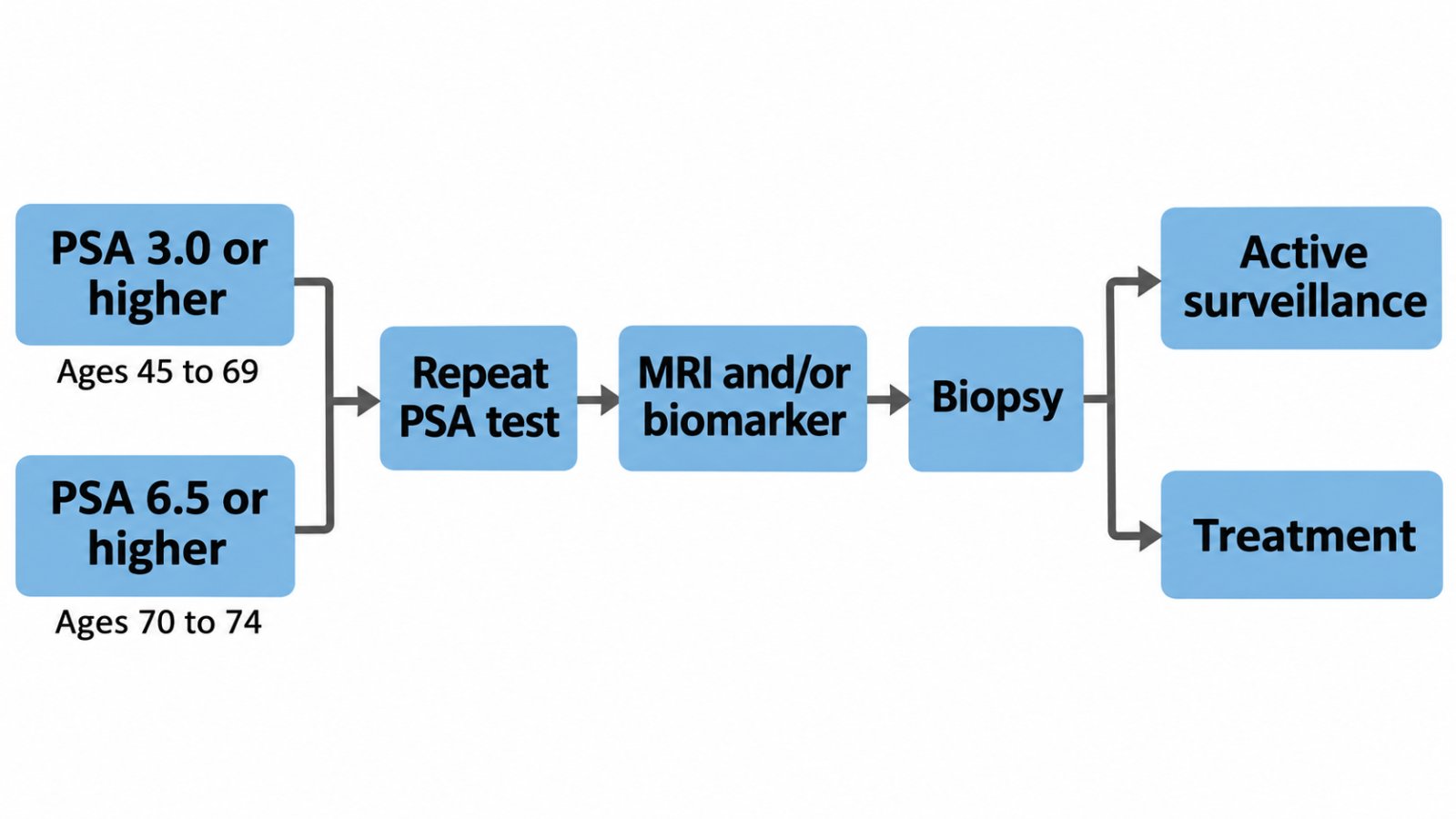
PSA, or prostate-specific antigen, is a protein made by the prostate and measured in a blood sample in nanograms per milliliter (ng/mL). A reading of 3.0 ng/mL or higher counts as elevated for men aged 45 to 69, the ACS press release says, and the threshold rises to 6.5 ng/mL for men 70 to 74.
One elevated reading does not by itself move a man to the next stage. The release calls for the test to be repeated within two weeks to three months before any further step is taken.
Overdiagnosis is the harm that screening guidelines weigh against the benefit of finding cancer early. It means finding a cancer that grows so slowly it would never have caused symptoms or shortened a man's life, which may then be treated anyway, with the risks that treatment carries.
A report by STAT on the new guideline quotes this assessment of PSA screening to date: "There have been many men undergoing unnecessary biopsies, and many low risk cancers that were subsequently overtreated." The ACS explainer lists the harms of screening and points to active surveillance for low-risk cancers, under which a man is checked with repeat tests over time instead of being treated straight away.
On the side of benefit, the explainer gives a 5-year relative survival rate above 99%. That measure compares men diagnosed with prostate cancer with men of the same age in the general population, so it describes survival after diagnosis and is not a count of deaths that screening prevents.
No number for deaths prevented by screening, or for men overdiagnosed by it, appears in the ACS release, the explainer or the STAT report.
If the repeat test is still elevated, the press release says the next step is magnetic resonance imaging (MRI), a validated biomarker test, or both, to guide the decision on whether to do a biopsy. Those results do not replace the procedure, because "a biopsy is still required to diagnose prostate cancer," according to the ACS explainer.
The guideline appeared in a journal for clinicians, and the facts it uses to place a man on a schedule are his age, whether he is Black, and how many first-degree relatives have had prostate cancer and at what age. The ACS explainer adds the part that inherited gene mutations play.
Once testing starts, the press release sets out the thresholds that mark a result as elevated and the path that follows, from a repeat test to MRI, a biomarker or both before any biopsy. The task force puts the choice in different terms: "the decision to be screened for prostate cancer should be an individual one," its recommendation summary says.

STAT reports that the task force has announced an upcoming update to its recommendation. The task force's grade affects whether insurers cover screening, so the update matters for coverage as well as for medical advice. The date of the update is not known.
Sources: American Cancer Society press release and explainer; CA: A Cancer Journal for Clinicians; U.S. Preventive Services Task Force; STAT; Guideline Central. The Ars Technica report on the guideline was not available at the time of writing.

Dennis Mwangi
Dennis Mwangi covers nutrition and fitness news. He reads the new studies behind each story and reports what they actually found.
View profileRecommended for you
More stories →
Foundayo for Sleep Apnea: What the Trial Shows Next to Zepbound and CPAP

Do Alcohol Calories Count? The 98-Calorie Floor and What Comes With It

Three Dairy Servings a Day for 12 Weeks: What the Trial Shows and Where It Stops

Leave a Comment